Gulf oil full of methane, adding new concerns
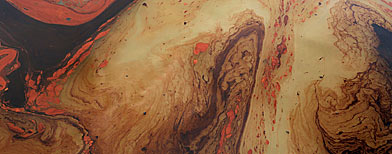




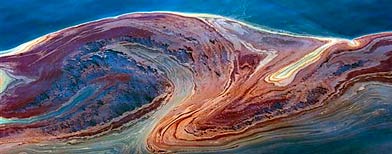
NEW ORLEANS – It is an overlooked danger in the oil spill crisis: The crude gushing from the well contains vast amounts of natural gas that could pose a serious threat to the Gulf of Mexico's fragile ecosystem.
The oil emanating from the seafloor contains about 40 percent methane, compared with about 5 percent found in typical oil deposits, said John Kessler, a Texas A&M University oceanographer who is studying the impact of methane from the spill.
That means huge quantities of methane have entered the Gulf, scientists say, potentially suffocating marine life and creating "dead zones" where oxygen is so depleted that nothing lives.
"This is the most vigorous methane eruption in modern human history," Kessler said.
Methane is a colorless, odorless and flammable substance that is a major component in the natural gas used to heat people's homes. Petroleum engineers typically burn off excess gas attached to crude before the oil is shipped off to the refinery. That's exactly what BP has done as it has captured more than 7.5 million gallons of crude from the breached well.
A BP spokesman said the company was burning about 30 million cubic feet of natural gas daily from the source of the leak, adding up to about 450 million cubic feet since the containment effort started 15 days ago. That's enough gas to heat about 450,000 homes for four days.
But that figure does not account for gas that eluded containment efforts and wound up in the water, leaving behind huge amounts of methane. Scientists are still trying to measure how much has escaped into the water and how it may damage the Gulf and it creatures.
The dangerous gas has played an important role throughout the disaster and response. A bubble of methane is believed to have burst up from the seafloor and ignited the rig explosion. Methane crystals also clogged a four-story containment box that engineers earlier tried to place on top of the breached well.
Now it is being looked at as an environmental concern.
The small microbes that live in the sea have been feeding on the oil and natural gas in the water and are consuming larger quantities of oxygen, which they need to digest food. As they draw more oxygen from the water, it creates two problems. When oxygen levels drop low enough, the breakdown of oil grinds to a halt; and as it is depleted in the water, most life can't be sustained.
The National Science Foundation funded research on methane in the Gulf amid concerns about the depths of the oil plume and questions what role natural gas was playing in keeping the oil below the surface, said David Garrison, a program director in the federal agency who specializes in biological oceanography.
"This has the potential to harm the ecosystem in ways that we don't know," Garrison said. "It's a complex problem."
BP CEO Tony Hayward on Thursday told Congress members that he was "so devastated with this accident," "deeply sorry" and "so distraught."
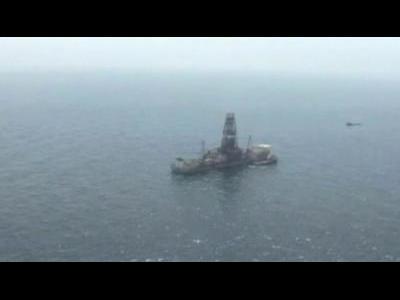
But he also testified that he was out of the loop on decisions at the well and disclaimed knowledge of any of the myriad problems on and under the Deepwater Horizon rig before the deadly explosion. BP was leasing the rig the Deepwater Horizon that exploded April 20, killing 11 workers and triggering the environmental disaster.
"BP blew it," said Rep. Bart Stupak, D-Mich., chairman of the House investigations panel that held the hearing. "You cut corners to save money and time."
In early June, a research team led by Samantha Joye of the Institute of Undersea Research and Technology at the University of Georgia investigated a 15-mile-long plume drifting southwest from the leak site. They said they found methane concentrations up to 10,000 times higher than normal, and oxygen levels depleted by 40 percent or more.
The scientists found that some parts of the plume had oxygen concentrations just shy of the level that tips ocean waters into the category of "dead zone" — a region uninhabitable to fish, crabs, shrimp and other marine creatures.
Kessler has encountered similar findings. Since he began his on-site research on Saturday, he said he has already found oxygen depletions of between 2 percent and 30 percent in waters 1,000 feet deep.
Shallow waters are normally more susceptible to oxygen depletion. Because it is being found in such deep waters, both Kessler and Joye do not know what is causing the depletion and what the impact could be in the long- or short-term.
In an e-mail, Joye called her findings "the most bizarre looking oxygen profiles I have ever seen anywhere."
Representatives of the National Oceanic and Atmospheric Administration acknowledged that so muchmethane in the water could draw down oxygen levels and slow the breakdown of oil in the Gulf, but cautioned that research was still under way to understand the ramifications.
"We haven't seen any long-term changes or trends at this point," said Robert Haddad, chief of the agency's assessment and restoration division.
Haddad said early efforts to monitor the spill had focused largely on the more toxic components of oil. However, as new data comes in, he said NOAA and other federal agencies will get a more accurate read on methane concentrations and the effects.
"The question is what's going on in the deeper, colder parts of the ocean," he said. "Are the (methane) concentrations going to overcome the amount of available oxygen? We want to make sure we're not overloading the system."
BP spokesman Mark Proegler disputed Joye's suggestion that the Gulf's deep waters contain large amounts of methane, noting that water samples taken by BP and federal agencies have shown minimal underwater oil outside the spill's vicinity.
"The gas that escapes, what we don't flare, goes up to the surface and is gone," he said.
Steven DiMarco, an oceanographer at Texas A&M University who has studied a long-known "dead zone" in the Gulf, said one example of marine life that could be affected by low oxygen levels in deeper waters would be giant squid — the food of choice for the endangered sperm whale population. Squid live primarily in deep water, and would be disrupted by lower oxygen levels, DiMarco said.
Meanwhile, the Coast Guard signaled a shift in strategy Friday to fight the oil, saying it was ramping up efforts to capture the crude closer to shore.
Coast Guard Adm. Thad Allen said an estimated 2,000 private boats in the so-called "vessels of opportunity" program will be more closely linked through a tighter command and control structure to direct them to locations less than 50 miles offshore to skim the oil. Allen, the point man for the federal response to the spill, previously had said surface containment efforts would be concentrated much farther offshore.
____
Brown reported from Billings, Mont.
http://news.yahoo.com/s/ap/20100618/ap_on_bi_ge/us_gulf_oil_spill