Tampilkan postingan dengan label Haiti Quake. Tampilkan semua postingan

Rabu, 20 Januari 2010

Haiti quake creates thousands of new orphans

Haiti quake creates thousands of new orphans


The first of 53 Haitian orphans, whose orphanage was destroyed by last week'sAP – The first of 53 Haitian orphans, whose orphanage was destroyed by last week's massive earthquake, is …

PORT-AU-PRINCE, Haiti – The 5-month-old patient at the Israeli field hospital has a number rather than a name.

No one even knows who dropped the barely conscious child at the makeshift medical center after he was pulled from the debris of a collapsed building four days after last week's catastrophic quake. Now recovering, doctors have a difficult decision ahead.

"What will we do with him when we are finished?" said Dr. Assa Amit of the hospital's pediatric emergency department.

No one knows who the boy's family is, or whether any of his relatives are alive.

Tens of thousands of children have been orphaned by the earthquake, aid groups say — so many that officials won't venture a number. With so many buildings destroyed and growing chaos in the capital, it is conceivable that many children are alone.

"As yet they are still on the streets," said Elizabeth Rodgers, of the Britain-based international orphan group SOS Children. "Without doubt, most of them are in the open."

Even before Tuesday's deadly magnitude-7.0 earthquake, Haiti, one of the world's poorest countries, was awash in orphans, with 380,000 children living in orphanages or group homes, the United Nations Children's Fund reported on its Web site.

Some of the children lost their parents in previous disasters, including four tropical storms or hurricanes that killed about 800 people in 2008, deadly storms in 2005 and 2004, and massive floods almost every other year since 2000. Others were abandoned amid the Caribbean nation's long-running political strife, which has led thousands to seek asylum in the U.S. — without their children — or by parents who were simply too poor to care for them.

International advocacy groups are trying to help, either by speeding up adoptions that were already in progress, or by sending in relief personnel to evacuate thousands of orphans to the U.S. and other countries.

On Tuesday, a flight carrying 53 Haitian children, from infants to age 10, landed in Pittsburgh, Pennsylvania, the first in a wave of orphans expected to be evacuated from the shattered Caribbean nation.

Workers disembarked the plane, some of them carrying children in their arms, and boarded waiting buses. Other children walked off the plane, waving at onlookers.

They will be taken to Children's Hospital of Pittsburgh for medical care and be placed in group homes until their adoptions are finalized.

Pennsylvania Gov. Ed Rendell and other officials escorted them from Haiti, where their orphanage was destroyed in the quake and their American caretakers spent days in dire need of food and water.

On Monday, the Dutch government sent a planeload of immigration officials to Haiti who will try to locate and evacuate 100 children who were already being adopted by Dutch parents.

Indiana-based Kids Alive International, which runs orphanages around the world, is expected to take 50 Haitian orphans to group homes in the Dominican Republic, the organization said in a news release.

U.S. Homeland Security spokesman Sean Smith said that orphans who have ties to the U.S. — such as a family member already living here — are among those who can get special permission to remain in the United States.

Notwithstanding the U.S. policy, the Catholic Church in Miami is working on a proposal that would allow thousands of orphaned children to come permanently to America. A similar effort launched in 1960, known as Operation Pedro Pan, brought about 14,000 unaccompanied children from Cuba to the U.S.

Under the new plan, dubbed "Pierre Pan," Haitian orphans would first be placed in group homes and then paired with foster parents, said Mary Ross Agosta, spokeswoman for the Archdiocese of Miami.

"We have children who are homeless and possibly without parents and it is the moral and humane thing to do," Agosta said.

Archdiocese officials said many details would have to be worked out, and President Barack Obama's administration would have to grant orphans humanitarian parole to enter the U.S.

In the meantime, U.N. humanitarian chief John Holmes said the United Nations is establishing a group whose mission on the ground in Haiti will be to protect children — orphans and non-orphans alike — against trafficking, kidnapping and sex abuse.

And orphanages that were operating in Haiti before the earthquake are scrambling to keep their kids safe, sheltered and fed. Those with damaged buildings are pledging to rebuild and take in more children, if needed.

Three of the four orphanages operated in Port-au-Prince by Planting Peace, a Melbourne, Fla., nonprofit, have been damaged, forcing staff to move everyone into one building. They are now trying to secure homes in Haitifor the kids, the group's founder, Aaron Jackson, told The Associated Press in an e-mail. Rainn Wilson, who appears in the TV show "The Office," is raising money for the group, Jackson said.

Jackson said all 37 of his orphans are physically fine and he would like to help more children.

"There needs to be some communication from the government level about what we need to do. Can we take these children?" he said. "We're ready. We've already raised a fair amount of money where we can go out and get an orphanage running soon."

Sherrie Fausey had to evacuate 30 children from her Christian Light Foundation orphanage in the capital after her facility was badly damaged in the quake.

Fausey, a former Florida elementary school teacher who came to Haiti 10 years ago, acknowledges that her job — daunting before the quake — has become even more challenging now.

"Wherever the Lord sends you, he'll make you content to be there," she said. "Times can be hard, but I'd rather be here in all this rubble. It's where my kids are."

At the Israeli field hospital, doctors are expecting to treat many more orphans in the coming days.

On one of the hospital's stretchers, Patient No. 236, a 6-month-old boy, lay on a hospital stretcher, crying in pain. Relatives brought him to the medical center shortly after the disaster, then left. They didn't tell anyone the boy's name.

Doctors suspect the infant had meningitis long before the earthquake — and they also suspect that no one is coming back for him.

"We will wait to discharge him until there is a facility that can grant continuous care," Amit said.

_________

Associated Press Writers Curt Anderson and Matt Sedensky in Miami, Dan Nephin in Coraopolis, Pennsylvania, and Edith M. Lederer at the United Nations contributed to this report.

http://news.yahoo.com/s/ap/20100119/ap_on_re_la_am_ca/cb_haiti_orphans

Kamis, 14 Januari 2010

Tens of thousands feared dead after Haiti quake

Tens of thousands feared dead after Haiti quake


The sun sets behind the crumpled National Palace Port-au-Prince, Wednesday, Jan.AP – The sun sets behind the crumpled National Palace Port-au-Prince, Wednesday, Jan. 13, 2010. The powerful …

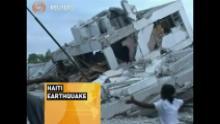
PORT-AU-PRINCE, Haiti – Dazed survivors wandered past dead bodies in rubble-strewn streets Wednesday, crying for loved ones, and rescuers searched collapsed buildings as officials feared the death toll from Haiti's devastating earthquake could reach into the tens of thousands.

The first cargo planes with food, water, medical supplies, shelter andsniffer dogs headed to the Western Hemisphere's poorest nation a day after the magnitude-7 quake flattened much of the capital of 2 million people.

Tuesday's earthquake brought down buildings great and small — from shacks in shantytowns to President Rene Preval's gleaming whiteNational Palace, where a dome tilted ominously above the manicured grounds.

Hospitals, schools and the main prison collapsed. The capital's Roman Catholic archbishop was killed when his office and the main cathedral fell. The head of the U.N. peacekeeping mission was missing in the ruins of the organization's multistory headquarters.

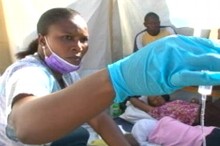
At a triage center improvised in a hotel parking lot, people with cuts, broken bones and crushed ribs moaned under tent-like covers fashioned from bloody sheets.

"I can't take it any more. My back hurts too much," said Alex Georges, 28, who was still waiting for treatment a day after the school he was in collapsed and killed 11 classmates. A body lay a few feet away.

"This is much worse than a hurricane," said doctors' assistant Jimitre Coquillon. "There's no water. There's nothing. Thirsty people are going to die."

Bodies were everywhere in Port-au-Prince: those of tiny children adjacent to schools, women in the rubble-strewn streets with stunned expressions frozen on their faces, men hidden beneath plastic tarps and cotton sheets.

Haiti's leaders struggled to comprehend the extent of the catastrophe — the worst earthquake to hit the country in 200 years — even as aftershocks still reverberated.

"It's incredible," Preval told CNN. "A lot of houses destroyed, hospitals, schools, personal homes. A lot of people in the street dead. ... I'm still looking to understand the magnitude of the event and how to manage."

Preval said thousands of people were probably killed. Leading Sen. Youri Latortue told The Associated Press that 500,000 could be dead, but conceded that nobody really knows.

"Let's say that it's too early to give a number," Preval said.

Haiti seems especially prone to catastrophe — from natural disasters like hurricanes, storms, floods and mudslides to crushing poverty, unstable governments, poor building standards and low literacy rates.

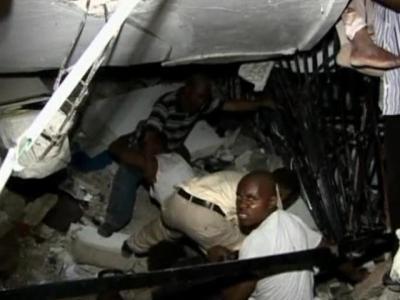
In Petionville, next to the capital, people used sledgehammers and their bare hands to dig through a collapsed commercial center, tossing aside mattresses and office supplies. More than a dozen cars were entombed, including a U.N. truck.

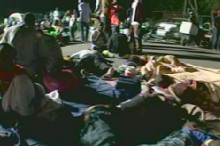
Nearby, about 200 survivors, including many children, huddled in a theater parking lot using sheets to rig makeshift tents and shield themselves from the sun.

Looting began almost as quickly as the quake struck at 4:53 p.m. and people were seen carrying food from collapsed buildings. Many lugged what they could salvage and stacked it around them as they slept in streets and parks.

People streamed into the Haitian countryside, where wooden and cinderblock shacks showed little sign of damage. Many balanced suitcases and other belongings on their heads. Ambulances and U.N. trucks raced in the opposite direction, toward Port-au-Prince.

About 3,000 police and international peacekeepers cleared debris, directed traffic and maintained security in the capital. But law enforcement was stretched thin even before the quake and would be ill-equipped to deal with major unrest.

An American aid worker was trapped for about 10 hours under the rubble of her mission house before she was rescued by her husband, who told CBS' "Early Show" that he drove 100 miles (160 kilometers) to Port-au-Prince to find her. Frank Thorp said he dug for more than an hour to free his wife, Jillian, and a co-worker, from under about a foot of concrete.

The international Red Cross said a third of the country's 9 million people may need emergency aid, a burden that would test any nation and a crushing catastrophe for impoverished Haiti.

President Barack Obama promised an all-out rescue and humanitarian effort and American officials said they were responding with ships, helicopters, transport planes and a 2,000-member Marine unit, as well as civilian emergency teams from across the U.S.

"We have to be there for them in their hour of need," Obama said.

The first C-130 plane carrying part of a military assessment team arrived in Haiti, the U.S. Southern Command said.

The U.S. Navy aircraft carrier, USS Carl Vinson, was expected to arrive off the coast of Haiti on Thursday. More U.S. Navy ships were under way as well, the U.S. Southern Command said.

A U.S. Coast Guard helicopter evacuated four critically injured U.S. Embassy staff to the hospital on the U.S. Naval base at Guantanamo Bay, Cuba, where the military has been detaining suspected terrorists.

A small contingent of U.S. ground troops could be on their way soon, although it was unclear whether they would be used for security operations or humanitarian efforts.

Cuba, which already had hundreds of doctors in Haiti, treated the injured in field hospitals. The aid group Doctors Without Borders helped quake victims in tent clinics set up to replace its damaged facilities.

Port-au-Prince's ruined buildings fell on both the poor and the prominent: The body of Archbishop Joseph Serge Miot, 63, was found in the ruins of his office, according to the Rev. Pierre Le Beller at Miot's order, the Saint Jacques Missionary Center in Landivisiau, France.

Senate President Kelly Bastien was among those trapped alive inside the Parliament building, and a day later had stopped responding to rescuers' cries, Latortue said.

Even the main prison in the capital fell down, "and there are reports of escaped inmates," U.N. humanitarian spokeswoman Elisabeth Byrs said in Geneva.

Haiti's quake refugees likely will face an increased risk of dengue fever, malaria and measles — problems that plagued the impoverished country before, said Kimberley Shoaf, associate director of the UCLA Center for Public Health and Disasters.

Some of the biggest immediate health threats include respiratory disease from inhaling dust from collapsed buildings and diarrhea from drinking contaminated water.

She said swamped clinics may not be able to give people help they need for broken bones and other injuries, leading to complications — a warning borne out on the streets where people, some covered in the dust of collapsed buildings, nursed wounds that bled through crude bandages.

The U.N.'s 9,000-member peacekeeping force sent patrols across the capital's streets while securing the airport, port and main buildings — but also struggled to rescue colleagues from their collapsed headquarters.

U.N. mission head Hedi Annabi of Tunisia was among about 150 people missing, mostly at the headquarters building, said peacekeeping chief Alain Le Roy. Brazilian Foreign Minister Celso Amorim said Annabi's chief deputy, Luis Carlos da Costa, was missing as well.

Le Roy said only about 10 people had been pulled out, many of them badly injured.

Brazil's army reported that at least 11 of its peacekeepers were killed. Jordan's official news agency said three of its peacekeepers were died.

The U.S. Embassy had no confirmed reports of deaths among the estimated 40,000-45,000 Americans who live in Haiti, but many were struggling to find a way out of the country.

Dozens were forced to abandon a Tuesday evening flight to Miami when the earthquake damaged the airport.

Kency Germain of Eatontown, N.J., kept his family — five adults and three children including his wife — at the airport until nearly 3 a.m. They made their way to the U.S. Embassy, where they were allowed to sleep briefly near the entrance.

"It was safer in there (the airport) than it was out there in Port-au-Prince," Germain said.

___

Associated Press contributors to this story: writers Mike Melia in Port-au-Prince; Edith M. Lederer at theUnited Nations; Frank Jordans and Bradley S. Klapper in Geneva; Matthew Lee and Julie Pace in Washington; Jamey Keaton in Paris; Tales Azzoni in Sao Paulo; Alicia Chang in Los Angeles, and Andrea Rodriguez in Havana.

http://news.yahoo.com/s/ap/cb_haiti_earthquake

Thousands feared dead in Haiti quake; many trapped

Thousands feared dead in Haiti quake; many trapped

Haiti's National Palace is seen damaged (Reuters)


n this image made available by the American Red Cross in London, Wednesday Jan.AP – n this image made available by the American Red Cross in London, Wednesday Jan. 13, 2010 shows earthquake …

PORT-AU-PRINCE, Haiti – Haitians piled bodies along the devastated streets of their capital Wednesday after a powerful earthquake flattened the president's palace, hospitals, schools, the main prison and thousands of homes. Untold numbers were still trapped.

President Rene Preval said he believes thousands of people were dead from Tuesday afternoon's magnitude-7.0 quake.

"Parliament has collapsed. The tax office has collapsed. Schools have collapsed. Hospitals have collapsed," Preval told the Miami Herald. "There are a lot of schools that have a lot of dead people in them."

Even the main prison in the capital fell, "and there are reports of escaped inmates," U.N. humanitarian spokeswoman Elisabeth Byrs said in Geneva.

The Roman Catholic archbishop of Port-au-Prince was among the dead, and the head of the U.N. peacekeeping mission was missing.

The international Red Cross said a third of Haiti's 9 million people may need emergency aid and that it would take a day or two for a clear picture of the damage to emerge.

At first light Wednesday, a U.S. Coast Guard helicopter evacuated four critically injured U.S. Embassy staff to the hospital on the U.S. Naval base at Guantanamo Bay, Cuba, where the military has been detaining suspected terrorists for the last seven years.

President Barack Obama promised an all-out rescue and humanitarian effort, adding that the U.S. commitment to its hemispheric neighbor will be unwavering.

"We have to be there for them in their hour of need," Obama said.

Other nations — from Iceland to Venezuela — said they would start sending in aid workers and rescue teams.Cuba said its existing field hospitals in Haiti had already treated hundreds of victims. The United Nations said Port-au-Prince's main airport was "fully operational" and open to relief flights.

The U.S. Navy aircraft carrier, USS Carl Vinson, is under way and expected to arrive off the coast of Haiti Thursday. Additional U.S. Navy ships are under way to Haiti, a statement from the U.S. Southern Command said.

Aftershocks continued to rattle the capital of 2 million people as women covered in dust clawed out of debris, wailing. Stunned people wandered the streets holding hands. Thousands gathered in public squares to sing hymns.

People pulled bodies from collapsed homes, covering them with sheets by the side of the road. Passers-by lifted the sheets to see if loved ones were underneath. Outside a crumbled building, the bodies of five children and three adults lay in a pile.

The prominent died along with the poor: the body of Archbishop Joseph Serge Miot, 63, was found in the ruins of his office, said the Rev. Pierre Le Beller of the Saint Jacques Missionary Center in Landivisiau, France. He told The Associated Press by telephone that fellow missionaries in Haiti had told him they found Miot's body.

Preval told the Herald that Haiti's Senate president was among those trapped alive inside the Parliament building. Much of the National Palace pancaked on itself.

The international Red Cross and other aid groups announced plans for major relief operations in the Western Hemisphere's poorest country.

Many will have to help their own staff as well as stricken Haitians. Taiwan said its embassy was destroyed and the ambassador hospitalized. Spain said its embassy was badly damaged.

Tens of thousands of people lost their homes as buildings that were flimsy and dangerous even under normal conditions collapsed. Nobody offered an estimate of the dead, but the numbers were clearly enormous.

"The hospitals cannot handle all these victims," said Dr. Louis-Gerard Gilles. "Haiti needs to pray. We all need to pray together."

An American aid worker was trapped for about 10 hours under the rubble of her mission house before she was rescued by her husband, who told CBS' "Early Show" that he drove 100 miles (160 kilometers) to Port-au-Prince to find her. Frank Thorp said he dug for more than an hour to free his wife, Jillian, and a co-worker, from under about a foot of concrete.

An estimated 40,000-45,000 Americans live in Haiti, and the U.S. Embassy had no confirmed reports of deaths among its citizens. All but one American employed by the embassy have been accounted for, State Department officials said.

Even relatively wealthy neighborhoods were devastated.

An AP videographer saw a wrecked hospital where people screamed for help in Petionville, a hillside district that is home to many diplomats and wealthy Haitians as well as the poor.

At a destroyed four-story apartment building, a girl of about 16 stood atop a car, trying to see inside while several men pulled at a foot sticking from rubble. She said her family was inside.

"A school near here collapsed totally," Petionville resident Ken Michel said after surveying the damage. "We don't know if there were any children inside." He said many seemingly sturdy homes nearby were split apart.

The U.N.'s 9,000 peacekeepers in Haiti, many of whom are from Brazil, were distracted from aid efforts by their own tragedy: Many spent the night hunting for survivors in the ruins of their headquarters.

"It would appear that everyone who was in the building, including my friend Hedi Annabi, the United Nations' secretary-general's special envoy, and everyone with him and around him, are dead," French Foreign Minister Bernard Kouchner said on RTL radio.

But U.N. peacekeeping chief Alain Le Roy would not confirm that Annabi was dead, saying he was among more than 100 people missing in its wrecked headquarters. He said only about 10 people had been pulled out, many of them badly injured. Fewer than five bodies had been removed, he said.

U.N. peacekeeping forces in Port-au-Prince are securing the airport, the port, main buildings and patrolling the streets, Le Roy said.

Brazil's army said at least 11 of its peacekeepers were killed, while Jordan's official news agency said three of its peacekeepers were killed. A state newspaper in China said eight Chinese peacekeepers were known dead and 10 were missing — though officials later said the information was not confirmed.

The quake struck at 4:53 p.m., centered 10 miles (15 kilometers) west of Port-au-Prince at a depth of only 5 miles (8 kilometers), the U.S. Geological Survey said. USGS geophysicist Kristin Marano called it the strongest earthquake since 1770 in what is now Haiti.

Video obtained by the AP showed a huge dust cloud rising over Port-au-Prince shortly after the quake as buildings collapsed.

Most Haitians are desperately poor, and after years of political instability the country has no real construction standards. In November 2008, following the collapse of a school in Petionville, the mayor of Port-au-Prince estimated about 60 percent of buildings were shoddily built and unsafe normally.

The quake was felt in the Dominican Republic, which shares the island of Hispaniola with Haiti, and in eastern Cuba, but no major damage was reported in either place.

With electricity out in many places and phone service erratic, it was nearly impossible for Haitian or foreign officials to get full details of the devastation.

"Everybody is just totally, totally freaked out and shaken," said Henry Bahn, a U.S. Department of Agriculture official in Port-au-Prince. "The sky is just gray with dust."

Edwidge Danticat, an award-winning Haitian-American author was unable to contact relatives in Haiti. She sat with family and friends at her home in Miami, looking for news on the Internet and watching TV news reports.

"You want to go there, but you just have to wait," she said. "Life is already so fragile in Haiti, and to have this on such a massive scale, it's unimaginable how the country will be able to recover from this."

___

Associated Press contributors to this story: videographer Pierre Richard Luxama in Port-au-Prince; and writers David Koop and Olga R. Rodriguez in Mexico City; David McFadden and Danica Coto in San Juan, Puerto Rico; Matthew Lee and Julie Pace in Washington; Edith M. Lederer at the United Nations; Tamara Lush in Tampa, Fla.; and Jennifer Kay and Christine Armario in Miami.

http://news.yahoo.com/s/ap/cb_haiti_earthquake;_ylt=AoHpP0D8u71pl5bQAgg1SLhH2ocA;_ylu=X3oDMTE2dnVqbXAwBHBvcwMxBHNlYwN5bi1yLWItbGVmdARzbGsDLXRob3VzYW5kc2Zl