Tampilkan postingan dengan label Irene. Tampilkan semua postingan

Jumat, 02 September 2011

Ham Radio Operators Still Active From Irene


Ham Radio Operators Still Active From Irene


REUTERS/Lucas Jackson
Flood waters remain several feet deep in Wayne, New Jersey. More Photos »
Emergency communications before, during and after hurricane.

(PRWEB) September 02, 2011
Amateur Radio operators (often called “hams”) continue to provide emergency communications in New York and Vermont where Hurricane Irene’s flooding isolated whole areas. According to the ARRL – the national association for Amateur Radio, specially trained volunteer hams from surrounding regions were brought in at the request of Greene County, NY authorities. Greene County was devastated by flooding following Irene. Radio amateurs are also aiding the American Red Cross relief efforts by providing technical expertise and working with their communications staff.
The work of the Amateur Radio operators began many days before Hurricane Irene made landfall when the hams turned their hobby activities into important communications networks that relayed storm information to the National Hurricane Center in Miami. As Irene’s winds began hitting the East Coast, more hams came on the air to provide critical weather spotting information to the National Weather Service’s Skywarn Program. The real-time, ground level reporting by Amateur Radio operators allowed the weather forecasters to make more accurate predictions and warnings. Doppler radar cannot see what is actually happening at ground level and the hams’ reports, especially when tornadoes are possibly mixed into a hurricane’s winds, can be lifesaving.
From South Carolina through New England, thousands of hams turned on their radios to monitor and report the effects of the storm. Others served in 9-1-1 and Emergency Operations Centers, hundreds of shelters and communications centers.    The technical skills of the ham operators, in addition to the wide variety of ways they can communicate when other systems may fail or get overloaded, were reassuring to the many agencies they served. Like firefighters, you hope you don’t need them, but as FEMA’s Director Craig Fugate remarked, “When you need Amateur Radio, you really need them!”
ARRL, the American Radio Relay League, is the 156,000 member national association for Amateur Radio in the USA. Its Amateur Radio Emergency Services (ARES) program provides trained volunteers and communications for served agencies ranging from the American Red Cross and FEMA/DHS to hundreds of county and municipal emergency operations throughout the country. To learn more about Amateur Radio in emergencies, go to http://www.emergency-radio.org.
###

Rabu, 31 Agustus 2011

State-by-state look at Irene dangers, damage

State-by-state look at Irene dangers, damage

Irene, the hurricane that weakened to a tropical storm, thrashed the East Coast, knocking out power to millions of homes and businesses, destroying piers and killing at least 38 people in 11 states. Here's a state-by-state glance on how it's affected states along the Eastern seaboard:

CONNECTICUT

__ The storm hit Connecticut on Sunday with 60 mph winds and drenching rain, destroying dozens of homes along the shoreline.

__ More than 674,000 utility customers still were without electricity Monday afternoon. At the peak out of the outages Sunday, about 775,000 customers were without electricity.

__ Connecticut tax officials are extending some business tax filing deadlines by a week — from Aug. 31 to Sept. 7 — because of Tropical Storm Irene.

DELAWARE

__ Two men who decided to sprint through hurricane at peak of the storm were found dead Monday in a waterway in a northern town.

__ About 7,600 homes and businesses without power as of late Monday afternoon.

__ Apparent tornado damages 15 structures near Lewes. No injuries reported.

__ Residents of a small coastal community were left isolated from their homes after an access road through Prime Hook National Wildlife Refuge in southern Delaware was washed out.

__ Governor says worst of Irene passed Sunday; he went on a helicopter tour of affected areas.

__ 16,000 chickens died when a Kent County poultry house was flooded during the storm.

FLORIDA

__ Hurricane kicked up heavy waves killing a 55-year-old surfer; a New Jersey tourist, also died in rough surf.

MAINE

__ Wind, heavy rains reached the state Sunday; the wind died down ended Monday.

__ More than 300,000 customers were without power at some point during storm; around 190,000 outages remained Monday afternoon.

__ Winds reached 49 mph on land, 8-9 inches of rain in western areas of state resulting in flash floods.

__ 200 roads and 12 bridges closed by floods or fallen trees.

__ Gov. Paul LePage toured Carrabassett Valley and Rumford areas of western Maine by helicopter to survey highway and bridge damage.

MARYLAND

Gov. Martin O'Malley says about 443,000 electricity customers remained without power Monday afternoon.

__ Up to 12 inches of rain fell on Ocean City.

__ Maryland Transit Administration restored service Sunday after suspending it.

MASSACHUSETTS

__ Rivers that overflowed their banks in Massachusetts because of Tropical Storm Irene washed out roads, swamped cornfields and dislodged a covered bridge.

__ More than 400,000 customers in the state remained without electricity at midday Monday.

__ Public transportation in Boston reopened Monday morning after being shut down for most of the day Sunday. Logan International Airport is also back to normal.

__ Gov. Deval Patrick toured hard-hit areas Monday by ground and air.

NEW HAMPSHIRE

__ Drenching rain and high winds reached state Sunday afternoon.

__ 175,000 homes and businesses were without power at the peak of the storm, 113,000 outages by Monday.

__ 200 local roads and 42 state roads closed from flooding and downed trees.

__ 250 people used nearly two dozen shelters, which had a capacity of 4,000 people.

NEW JERSEY

__ Irene hit at Little Egg Inlet north of Atlantic City early Sunday, only the third to make landfall in the state in the last 200 years.

__ About 600,000 homes and businesses were without power Monday afternoon, down from over 900,000.

__ Atlantic City casinos resume operations after rare shutdown.

__ Floodwaters remained on tracks in Trenton, N.J. on Monday, preventing Amtrak service between Boston and Philadelphia.

__Beaches on state's longest barrier island, Long Beach island, found to have lost 4 to 5 feet of height and up to 150 feet of width.

NEW YORK

__ Irene made landfall Sunday near Coney Island in New York City.

__ Massive rains upstate swelled waterways, shredding roads, knocking out bridges and tearing buildings off foundations in several counties.

__ Officials rescued 191 people.

__ At its peak, 945,000 homes and businesses statewide lost power, about half on Long Island. By Monday afternoon, 808,000 were still without power.

__ New York's major airports reopened Monday.

__ New York City's public transit system, the nation's biggest, was shut down until at least Monday.

__ Some traders at the New York Stock Exchange slept above the trading floor to be there for Monday's opening bell. It rang on time at exactly 9:30.

NORTH CAROLINA

__ The storm that made landfall at Cape Lookout on Saturday and then steamed up the East Coast.

__ Overall there were about 239,000 outages across eastern North Carolina late Monday.

__Local officials reported a 13-foot surge from Pamlico Sound into Beaufort County.

__ Nearly 1,900 prisoners evacuated from three coastal prisons.

__ Gov. Beverly Perdue and other officials offered assurance that the state's beaches, North Carolina's top tourism destination, are ready for Labor Day.

PENNSYLVANIA

__ Fears of flooding by the Delaware River in eastern Pennsylvania after it crested at just more than 25 feet and stayed within its banks.

__ The number of customers without power fell to 443,000 Monday from 706,000 the day before

__ Public transit in Philadelphia was up and running, save for a few regional trains.

RHODE ISLAND

__ Irene made landfall Sunday as a tropical storm.

__ As many as 340,000 of the state's electrical customers lost power after Irene. The number was down to 276,328 Monday evening.

__ Rhode Island health officials issued a boil-water advisory for about 1,000 residents statewide after several water systems lost pressure due to electricity outages caused by Irene.

SOUTH CAROLINA

__ Beach erosion reported at high tide Friday evening on Edisto Island and Folly Beach.

__ About 5,000 customers lost power from storms in Irene's outer bands.

__ Irene moved away from the state Saturday morning.

VERMONT

__ Gov. Peter Shumlin says flooding from Irene is the worst in the state in a century.

— Whole communities are cut off, almost 50,000 customers are without power, and hundreds of roads are closed.

__ At least a dozen bridges have washed away.

__ The Vermont State Hospital was evacuated after flood waters threatened the facility in Waterbury.

VIRGINIA

__ The storm battered two-thirds of Virginia during its weekend assault on the region.

__ About 514,320 customers remained without power Monday afternoon, most in the Richmond area.

__ Suffolk received 11 inches of rain, and other localities east of Interstate 95 received about 5-10 inches.

__ Hampton Roads area saw near-record storm surge that could lead to flooding. Gov. Bob McDonnell and other officials took an aerial tour of the area.

WASHINGTON, D.C.

__ About 7,700 homes and businesses without power.

__ About 200 trees were down around the city.

__ Washington National Cathedral officials say Hurricane Irene has not worsened any damage from last week's earthquake that caused significant damage at the church.

__ Approach of hurricane forced postponement of Sunday's dedication of Martin Luther King Jr. Memorial.

__ Public transit in nation's capital never shut down.

http://news.yahoo.com/state-state-look-irene-dangers-damage-184054882.html

Selasa, 30 Agustus 2011

Vermont, New Jersey flooded as Irene spares NYC

Vermont, New Jersey flooded as Irene spares NYC

FAIRFIELD, N.J./BRATTLEBORO, Vermont (Reuters) - New Jersey and Vermont struggled with their worst flooding in decades on Monday, a day after Hurricane Irene slammed an already soaked U.S. Northeast with torrential rain, dragging away homes and submerging neighborhoods underwater.

The massive storm churned up the U.S. East Coast over the weekend killing at least 38 people in 11 states, in addition to three who died in the Dominican Republic and one in Puerto Rico when the storm was still in the Caribbean, authorities said.

Spared from Irene's worst fury, New York City went back to work on Monday despite a partially crippled mass transit system and power outages that left 100,000 customers in the metropolitan area and nearly 1 million in the state without electricity.

Overall, some 5.1 million homes and businesses were still without power from North Carolina to Maine, and utilities said it could take days to restore electricity in more accessible areas and weeks in the hardest-hit regions.

Total economic damage could reach $20 billion, Standard & Poor's Senior Economist Beth Ann Bovino said. Hundreds of thousands of homes suffered damage, raising questions about how much would be covered by insurance as many homeowner policies do not cover flood damage.

In Fairfield, New Jersey, about 20 homes near the Passaic River were submerged, some in at least five feet of water. Some people waded chest high or rode canoes down the street, while others just sat and witnessed the flood from their stoops.

"This is the worst flood we have ever had," said Mike Chiafulio, 52, who could only watch as the water continued to rise around his mother's house. He said the flooding exceeding what he remembered from notable floods in 1968 and 1984.

The leafy suburb of Maplewood some 20 miles west of New York City was jarred by the sound of whirring generators, sirens and pumps emptying water from flooded houses.

Hundreds of thousands of people in New Jersey could be without electricity, water supplies or gas for days to come, their comfortable towns strewn with felled trees and branches blocking main roadways.

"We've had major rains before but we've never had flooding like this," said Ben Cohen, a retired judge who lives in Maplewood. "I can only vouch for the last 38 years but nothing even can come close to this."

In the town of Whippany, firefighters trained in swift water rescue pulled two youths out of the raging Whippany River, Deputy Fire Chief Randy Polo said.

Dumped from a raft at a man-made waterfall in the river, one teen was clinging to a log and the other to a broken tree limb in the thundering current, Polo said. The rescue took about an hour, he said.

"They were grateful, to say the least," Polo said.

OBAMA PLEDGES AID

"It's going to take time to recover from a storm of this magnitude," President Barack Obama told reporters in Washington. "The effects are still being felt across much of the country, including in New England and states like Vermont where there's been an enormous amount of flooding.

"I'm going to make sure that FEMA (Federal Emergency Management Agency) and other agencies are doing everything in their power to help people on the ground."

Vermont officials called it the state's worst flooding since 1927.

Air travel at New York City's three major area airports slowly resumed service, and financial markets operated normally, although volumes were low.

More than 12,000 East Coast flights were canceled and it could take three days to restore normal service, the industry group Air Transport Association said.

New York City subways returned to service, but many commuter lines to the city and national train carrier Amtrak were disrupted due to tracks that were flooded or blocked with fallen trees and debris.

While Irene failed to produce the devastation many had expected when New York City preemptively ordered unprecedented evacuations and a shutdown of its mass transit system on Saturday, it still left hundreds of thousands of homeowners with flood damage, especially in New Jersey and Vermont.

"I keep being somewhat disappointed by some of the national press that think because Manhattan wasn't hit, everything is fine. We're not Manhattan, but we have human lives here in Vermont, too," Governor Peter Shumlin said after surveying washed out roads and bridges and homes bobbing in the water.

Shumlin visited the Whetstone Studio for the Arts in Brattleboro, an artsy community of 12,000 along the Connecticut River. Gushing water ate away at the building and left its second floor dangling precariously over the flood.

MASSIVE RAINFALL

Some 5 to 15 inches of rain fell over a 24- to 36-hour period in northeastern states, said David Vallee, a hydrologist with the National Weather Service, creating moderate to major flooding in parts of eastern New York state, the Connecticut River valley and much of northern New Hampshire and Vermont.

Fairfield, New Jersey, home to more than 7,000 people, was in danger of becoming an island as flooding from the Passaic River was expected to surpass that of a memorable flood in 1984, Essex County Sheriff Armando Fontoura said.

"We are surrounded already," said Gail Dupas, 36, who fled to a hotel after floodwaters on her street reached neck deep. "It's devastating. You have to grab what you can. Anything that's irreplaceable."

Alex Adams, 35, looked relieved as a Maplewood fire truck arrived at his house to pump out more than two feet of water that accumulated in his basement.

"It obliterated everything but we were most concerned about getting electrocuted," Adams said.

"My wife and I were in there pulling out everything when we realized water was over the outlets."

Even the mega wealthy were inconvenienced by Irene. Hedge fund magnate David Tepper was forced from his plush office in Millburn, New Jersey, as the fund's main offices lost power. Tepper is founder of hedge fund Appaloosa Management LP.

The costly cleanup will also further strain budgets of state and local governments, where economies have not recovered from the recession.

"It's a hit but not a fatal hit," said Joseph Seneca, a professor at Rutgers University's Edward J. Bloustein School of Planning and Public Policy. "The ability of states to respond (to the hurricane) is more constrained," Seneca said.

(Reporting by Christine Kearney in Fairfield, New Jersey; Scott Malone in Brattleboro, Vermont; Karen Pierog in Chicago; Svea Herbst-Bayliss, Toni Clarke and Lauren Keiper in Boston; Ben Berkowitz, Josh Schneyer and Edith Honan in New York; Tabassum Zakaria and Jeff Mason in Washington; David Warner in Philadelphia; Matthew Goldstein in Millburn, New Jersey; Grant McCool in Maplewood, New Jersey; Writing by Daniel Trotta; Editing by Eric Beech and Todd Eastham)

http://news.yahoo.com/vermont-jersey-flooded-irene-spares-nyc-001406826.html

Minggu, 28 Agustus 2011

WEAKENED HURRICANE IRENE BLASTS NEW YORK

WEAKENED HURRICANE IRENE BLASTS NEW YORK

By Sebastian Smith, AAPAugust 28, 2011, 9:08 pm

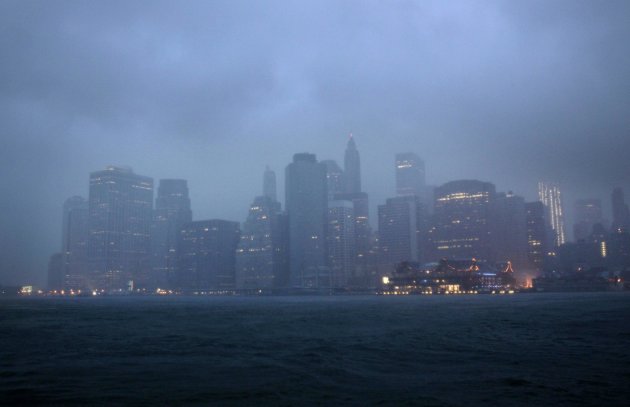
A weakened Hurricane Irene has torn into New York, hammering Manhattan's skyscrapers with fierce winds and threatening to flood the financial district after killing at least nine people along the US east coast.

The first hurricane to hit the Big Apple for a generation swept in overnight, accompanied by lightning, reports of tornados and deafening rainfall.

As Irene approached the New Jersey shore, its wind strength diminished substantially, dropping to just 75km/h, at the threshold of hurricane status. But it still remained a tremendous storm.

The hurricane made its second landfall near Atlantic City, New Jersey, just before sunrise on Sunday.

Meanwhile, New York City resembled a ghost town after 370,000 people were told to evacuate flood-prone areas, including near Wall Street and at Coney Island, and mass transport was shut down.

Trains, buses and the Staten Island ferry all shut down on Saturday, as did all nearby airports, paralysing the city.

Mayor Michael Bloomberg told a media conference that running from the storm was no longer possible.

"At this point, if you haven't evacuated, our suggestion is you stay where you are," he said. "Nature is a lot stronger than the rest of us."

Irene made US its first landfall at 8am (2200 AEST) on Saturday at Cape Lookout, North Carolina, near a chain of barrier islands and quickly proved deadly.

At least nine people died on Saturday - in car accidents, from heart attack and by falling trees - in North Carolina, Virginia and Florida. The youngest victim, an 11-year-old boy, died when a tree crashed through his apartment building in Newport News, Virginia.

The storm then re-entered the ocean off the coasts of Virginia and Maryland.

On its passage up the coast, Irene knocked out power supplies for well over a million people, triggered the cancellation of more than 8000 flights, and forced nearly two million people to evacuate, half of them in New Jersey.

Officials in New York said the biggest danger was from flooding caused not just because of tropical-style rainfall but a surge of wind-driven seawater pushing up from the Atlantic, especially at high tide early on Sunday.

City areas at risk of being swamped included parts of the financial district in Manhattan and low-lying beach resorts in Brooklyn and Queens and on nearby Long Island. Boat owners scrambled to get their craft ashore and officials across New Jersey and New York pleaded with residents to keep off beaches.

Officials say Manhattan's skyscrapers are not at risk of serious damage but warn that power outages might strand residents without light, water or lifts.

The disruption took on an international character after the area's three big airports - John F. Kennedy International Airport, LaGuardia and Newark - were ordered to stop all flights at 10pm (1200 AEST) .

The flightaware.com website, which tracks airport arrivals and departures, estimated 8337 flights would be cancelled during the weekend, mainly US domestic trips. It warned the figure would rise.

President Barack Obama, who cut short his summer holiday, visited the Federal Emergency Management Agency's operations centre in Washington, where he said the east coast was in for a "long 72 hours".

Obama chaired a meeting at the National Response Co-ordination Centre, set up to marshall federal and local hurricane-relief efforts.

"This is going to be a tough slog getting through this thing," Obama said during a video teleconference including senior federal officials and local government agencies.

About 65 million people live in the urban corridor from Washington north to Boston, and experts have said the damage could cost anything up to $US12 billion ($A11.5 billion) to restore.

"This is going to be a very serious storm, no matter what the track is, no matter how much it weakens. This is a life-threatening storm to people here," Bloomberg said.

Irene's approach stirred painful memories of Hurricane Katrina, which smashed into the southern Gulf Coast in 2005, stranding thousands of people in New Orleans and overwhelming poorly prepared local and federal authorities.

Hurricanes are rare in the northeastern US - the last big one to hit New York was Gloria in 1985 - but this time authorities say they are ready.

The military said up to 101,000 National Guard soldiers were available if needed and designated military bases in three states as staging areas.

Slower but still powerful, Irene hits land in NJ

Slower but still powerful, Irene hits land in NJ

NEW YORK (AP) — Barely a hurricane but massive and packed with rain, Irene lumbered onto the New Jersey shore Sunday morning on its way toward pummeling New York, which turned eerily quiet as the city hunkered down.

The National Hurricane Center said the center of the huge storm reached land near Little Egg Inlet, about 85 miles south-southwest of New York, at 5:35 a.m. The eye previously reached land Saturday in North Carolina before returning to the Atlantic, straddling the East Coast as it flooded towns, killed at least eight people and knocked out power to more than 3 million homes and businesses.

Broadway, baseball and most other things were shuttered in New York, where the transit system stopped because of weather for the first time in history. Mayor Michael Bloomberg warned late Saturday that no matter whether residents of low-lying areas heeded his calls to evacuate, "The time for evacuation is over. Everyone should now go inside and stay inside."

Hours before the storm's center was to reach New York, a 58 mph wind gust hit John F. Kennedy International Airport and a storm surge of more than 3.5 feet was reported in New York Harbor.

National Weather Service meteorologist Ashley Sears said a storm surge of 4 to 8 feet was expected to rush in just before the eye crosses land. Wind and rain should start diminishing by midafternoon, but if the storm surge deluges Lower Manhattan, the water could linger for hours or even a day.

By Sunday morning, the storm had sustained winds of 75 mph, down from 100 mph on Friday. That's just 1 mph more than the 74 mph minimum for a Category 1 hurricane, the least threatening on a 1-to-5 scale.

The total extent of damage Saturday was unclear, but officials and residents in some areas were relieved to find their communities with relatively minor problems. Forecasters said the storm remained capable of causing ruinous flooding with a combination of storm surge, high tides and 6 to 12 inches of rain.

"Everything is still in effect," National Hurricane Center spokesman Dennis Feltgen said. "The last thing people should do is go outside. They need to get inside and stay in a safe place until this thing is over."

Tornadoes were reported in Virginia, Maryland and Delaware, and several warnings were issued elsewhere, including New York and Philadelphia.

Irene caused flooding from North Carolina to Delaware, both from the seven-foot waves it pushed into the coast and from heavy rain. Eastern North Carolina got 10 to 14 inches of rain, according to the National Weather Service. Virginia's Hampton Roads area was drenched with at least nine inches, with 16 reported in some spots.

More than one million of the homes and businesses without power were in Virginia and North Carolina, the first states in the path of Irene's eye. Then the storm knocked out power overnight to hundreds of thousands in Washington, D.C., Maryland, Delaware, Pennsylvania, New Jersey, the New York City area and Connecticut.

In Virginia, three people were killed by falling trees and about 100 roads were closed. Emergency crews around the region prepared to head out at daybreak to assess the damage, though with some roads impassable and rivers still rising, it could take days.

Some held out optimism that their communities had suffered less damage than they had feared.

"I think it's a little strong to say we dodged a bullet. However, it certainly could have turned out worse for the Hampton Roads area," said National Weather Service meteorologist Mike Montefusco.

In Virginia Beach, the city posted on Twitter late Saturday that initial reports were promising, with the resort area suffering minimal damage. Ocean City, Md., Mayor Rick Meehan tweeted this synopsis: "Currently in OC sustained winds of 53mph and gust to 80mph. Rain total 11 inches. Scattered power outages. No reports of major damage!"

Charlie Koetzle was up at 4 a.m. on Ocean City's boardwalk. Asked about damage, he mentioned a sign that blew down.

"The beach is still here, and there is lots of it," he said. "I don't think it was as bad as they said it was going to be."

In North Carolina, where at least two people were killed, Gov. Beverly Perdue said Irene inflicted significant damage along the North Carolina coast and some areas were unreachable.

"Folks are cut off in parts of North Carolina, and obviously we're not going to get anybody to do an assessment until it's safe," she said.

Television coverage showed evidence of damage across eastern North Carolina with downed trees and toppled power lines.

A falling tree also killed one person in Maryland. A surfer and another beachgoer in Florida were killed in heavy waves caused by the storm.

The storm arrived in Washington just days after an earthquake damaged some of the capital's most famous structures, including the Washington Monument. Irene could test Washington's ability to protect its national treasures and its poor.

A nuclear reactor at Maryland's Calvert Cliffs went offline automatically when winds knocked off a large piece of aluminum siding that came into contact with the facility's main transformer late Saturday night. An "unusual event" was declared, the lowest of four emergency classifications by the Nuclear Regulatory Commission, but Constellation Energy Nuclear Group spokesman Mark Sullivan said the facility and all employees were safe.

Near Callway, Md., about 30 families were warned that a dam could spill over, causing significant flooding, and that they should either leave their homes or stay upstairs. St. Mary's County spokeswoman Sue Sabo said the dam was not in danger of breaching.

Irene made its official landfall just after first light near Cape Lookout, N.C., at the southern end of the Outer Banks, the ribbon of land that bows out into the Atlantic Ocean. Shorefront hotels and houses were lashed with waves, two piers were destroyed and at least one hospital was forced to run on generator power.

Across the Eastern Seaboard, at least 2.3 million people were under orders to move to somewhere safer. Thousands went to shelters and many found other places to stay, but some stayed put.

Annette Burton, 72, was asked to leave her Chester, Pa., neighborhood because of danger of rising water from a nearby creek. She said she planned to remain in the row house along with her daughter and adult grandson, although with a wary eye on the park across the street that routinely floods during heavy rains.

"I'm not a fool; if it starts coming up from the park, I'm leaving," she said. "It's the wind I'm more concerned about than anything."

As the storm's outer bands reached New York on Saturday night, two kayakers capsized and had to be rescued off Staten Island. They received summonses and a dressing-down from Bloomberg, who said at a press conference that they recklessly put rescuers' lives at risk.

Irene was the first hurricane to make landfall in the continental United States since 2008, and came almost six years to the day after Katrina ravaged New Orleans on Aug. 29, 2005. Experts said that probably no other hurricane in American history had threatened as many people.

Airlines said 9,000 flights were canceled, including 3,000 on Saturday. The number of passengers affected could easily be millions because so many flights make connections on the East Coast.

In New York, authorities undertook the herculean job of bringing the city to a halt. The Metropolitan Transportation Authority shut down its subways, trains and buses for a natural disaster for the first time, a job that began at noon Saturday and took into late that night to complete.

On Wall Street, sandbags were placed around subway grates near the East River because of fear of flooding. Tarps were spread over other grates. Construction stopped throughout the city, and workers at the site of the World Trade Center dismantled a crane and secured equipment.

The city was far quieter than on an average Saturday. In some of the busiest parts of Manhattan, it was possible to cross a major avenue without looking, and the waters of New York Harbor, which might normally be churning from boat traffic, were quiet. About 370,000 people living in low-lying areas of the city, mostly in Lower Manhattan, Brooklyn and Queens, were under orders to clear out.

New York has seen only a few hurricanes in the past 200 years. The Northeast is much more used to snowstorms — including a blizzard last December, when Bloomberg was criticized for a slow response.

___

Mitch Weiss reported from Nags Head, N.C. Associated Press writers contributing to this report were Tim Reynolds and Christine Armario in Miami; Bruce Shipkowski in Surf City, N.J.; Geoff Mulvihill in Trenton, N.J.; Wayne Parry in Atlantic City, N.J.; Eric Tucker in Washington; Martha Waggoner and Gary D. Robertson in Raleigh, N.C.; Jessica Gresko in Ocean City, Md.; Mitch Weiss in Nags Head, N.C.; Alex Dominguez in Baltimore; Dena Potter in Richmond, Va.; Brock Vergakis in Virginia Beach, Va.; Samantha Bomkamp and Jonathan Fahey in New York; and Seth Borenstein in Washington.

http://news.yahoo.com/slower-still-powerful-irene-hits-land-nj-103351113.html