BP report blames itself, others for oil spill
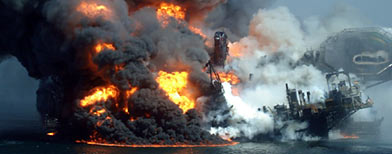


NEW ORLEANS – BP took some of the blame for the Gulf oil disaster in an internal report issued Wednesday, acknowledging among other things that it misinterpreted a key pressure test of the well. But in a possible preview of its legal strategy, it also pointed the finger at its partners on the doomed rig.
The highly technical, 193-page report attributes the worst offshore oilspill in U.S. history and the rig explosion that set it off to a complex chain of failures both human and mechanical. Some of those problems have been made public over the past 4 1/2 months, such as the failureof the blowout preventer to clamp the well shut.
The report is far from the definitive ruling on the cause of the catastrophe. For one thing, government investigators have not yet begun to fully analyze the blowout preventer, which was raised from the bottom of the sea over Labor Day weekend.
But it provides an early look at the company's probable legal strategy — spreading the blame among itself, rig owner Transocean, and cement contractor Halliburton — as it deals with hundreds of lawsuits, billions of dollars in claims and possible criminal charges in the coming months and years.
Critics of BP called the report self-serving.
"This report is not BP's mea culpa," said Rep. Edward J. Markey, D-Mass., a member of a congressional panel investigating the spill. "Of their own eight key findings, they only explicitly take responsibility for half of one. BP is happy to slice up blame as long as they get the smallest piece."
The report's conclusions stand in contrast to a widely seen BP ad campaign in which the company casts no blame for the explosion and vows to clean up and restore the Gulf Coast.
"BP blaming others for the Gulf oil disaster is like Bernie Madoff blaming his accountant," said Robert Gordon, an attorney for fishermen, hotels and restaurants affected by the spill. Another plaintiff's lawyer, W. Mark Lanier, scoffed: "This is like the ringleader of a lynch mob saying, `Well, I didn't bring the rope; he did.'"
The disaster began when the Deepwater Horizon exploded off the coast of Louisiana on April 20, killing 11 workers. BP's well spewed more than 200 million gallons of oil into the Gulf before a temporary cap stopped it in mid-July.
Members of Congress, industry experts and workers who survived the blast have accused BP's engineers of cutting corners to save time and money on a project that was 43 days and more than $20 million behind schedule at the time of the blast.
Nearly 24 hours before the explosion, Halliburton was using cement to seal the gap between the well casing and the hole drilled in the seafloor. It was also cementing the bottom of the well shut until the day BP was ready to begin extracting oil and gas from it.
In its report, BP said that it was a bad cementing job that contributed to the blowout and that the design of the well was probably not to blame. It also said "more thorough review and testing by Halliburton" and "stronger quality assurance" by BP's well team might have identified weaknesses in the plan for cementing.
The report acknowledged, as investigators have previously suggested, that BP's engineers and employees of Transocean misinterpreted a pressure test of the well's integrity before the explosion.
"The Transocean rig crew and BP well site leaders reached the incorrect view that the test was successful and that well integrity had been established," the investigators said.
They also blamed employees on the rig from both companies for failing to respond to other warning signs that the well was in danger of blowing out.
The words "blame" and "mistake" never appear in the report. "Fault" shows up 20 times, but only once in the same sentence as the company's name.
"The team did not identify any single action or inaction that caused this accident," the investigators said. "Rather, a complex and interlinked series of mechanical failures, human judgments, engineering design, operational implementation and team interfaces came together to allow the initiation and escalation of the accident. Multiple companies, work teams and circumstances were involved over time."
Mark Bly, who as BP's safety chief led the internal investigation, said the report was a reconstruction of what happened on the rig based on the company's data and interviews with mostly BP employees and was not meant to focus on assigning blame. The six-person investigating panel had access to only a few workers from other companies, and samples of the actual cement used in the well were not released to BP.
Transocean blasted the report as a self-serving attempt to conceal what it called the real cause of the explosion — "BP's fatally flawed well design."
Halliburton said it found a number of omissions and inaccuracies in the report and is confident the work it completed on the well met BP's specifications. "Contractors do not specify well design or make decisions regarding testing procedures as that responsibility lies with the well owner," the company said.
White House press secretary Robert Gibbs noted "there is an active investigation into what went wrong" and said the administration's job is to find out what happened and hold those responsible accountable. Federal prosecutors are among those investigating.
In Wednesday trading in New York, BP stock rose $1.18, or 3.2 percent, to close at $38.37.
Investigators know the explosion was triggered by a bubble of methane gas that shot up the drill column and ignited. But they don't know exactly how and why the gas escaped. And they don't know for certain why the blowout preventer didn't work.
But in its report, BP said the blowout preventer didn't do its job because it was damaged in the explosion and because it had a bad valve and weak batteries. Transocean, which was responsible for maintaining the blowout preventer, has insisted the batteries were in working order.
BP also said:
• Its use of six centralizers during the cementing, instead of the 21 recommended by Halliburton, probably did not contribute to the cement's failure. Centralizers make sure the casing is running down the center of the well bore. If the casing is cemented off-center, there is a risk of an imperfect seal that could allow oil and gas to escape.
• Just before the blast, the flammable gas leaking from the well was directed onto the rig instead of being vented overboard. The rig's ventilation system may have allowed the gas to enter the engine rooms, where it may have ignited.
• Recommendations should be considered to improve offshore drilling practices. It suggested, among other things, that standards for reporting and investigating incidents be clarified and strengthened.
Separately on Wednesday, the Obama administration said it sent a sixth bill, for $128.5 million, to BP and others for costs associated with the spill. The first five bills, totaling $389.9 million, have been paid in full by BP, the government said.
The disaster has already cost BP roughly $8 billion, not including a $20 billion victims' compensation fund it has agreed to set up.
___
Cappiello reported from Washington. Associated Press Writers Curt Anderson in Miami, Chris Kahn in New York and Seth Borenstein in Washington contributed to this report.
http://news.yahoo.com/s/ap/20100908/ap_on_bi_ge/us_gulf_oil_spill


