Tampilkan postingan dengan label Rain. Tampilkan semua postingan

Sabtu, 27 Agustus 2011

Hurricane Irene brings rain, heavy seas to coast

Hurricane Irene brings rain, heavy seas to coast

Click to see more Hurricane Irene images.

Click to see more Hurricane Irene images.

NAGS HEAD, N.C. (AP) — Hurricane Irene began lashing the East Coast with rain Friday ahead of a weekend of violent weather that was almost certain to heap punishment on a vast stretch of shoreline from the Carolinas to Massachusetts.

For hundreds of miles, people in the storm's path headed inland, made last-minute preparations and monitored the hurricane's every subtle movement. Irene had the potential to cause billions of dollars in damage all along a densely populated arc that included Washington, Baltimore, Philadelphia, New York, Boston and beyond. At least 65 million people were in its projected track.

As the storm trudged toward northwest from the Bahamas, rain from its outer bands began falling along the North and South Carolina coast. Swells and 6- to 9-foot waves were reported along the Outer Banks. Winds were expected to pick up later. Thousands had already lost power as the fringes of the storm began raking the shore.

The hurricane warning was extended into the Chesapeake Bay as far as Drum Point, and existing warnings remained in effect from North Carolina to New Jersey. A hurricane watch was in effect even farther north and included Long Island, Martha's Vineyard and Nantucket, Mass.

Risks from Irene's wrath were many: surging seas, drenching rains, flash floods and high winds. Craig Fugate had warned previously that this is one of the largest populations to be affected by one storm at one time. On Friday morning, he and Homeland Security Secretary Janet Napolitano pleaded with people to heed local officials' warnings.

"Evacuation orders are key," Fugate said. "People need to leave early, travel a safe distance, and get somewhere safe. All the preparation and planning will be in vain if people don't heed those evacuation orders."

President Barack Obama, who was vacationing in Martha's Vineyard, is set to return to the White House on Saturday when the storm is expected to pass through the Washington area. He said all indications point to Irene being a historic hurricane.

"I cannot stress this highly enough, if you are in the projected path of this hurricane you have to take precautions now," the president said.

Irene could also push crude oil prices higher if it disrupts refineries in Delaware, New Jersey, Pennsylvania and Virginia, which produce nearly 8 percent of U.S. gasoline and diesel fuel.

By late Friday morning, Irene remained a Category 2 storm with maximum sustained winds near 105 mph (169 kph). Little change in strength was expected by the time Irene reaches the North Carolina coast on Saturday, the National Hurricane Center said, but forecasters warned it would be a very large and dangerous storm nonetheless.

In North Carolina, traffic was steady Friday as people fled the Outer Banks and beach towns. A day earlier, tourists were ordered to leave the barrier islands, and many residents heeded authorities' admonitions to get out.

At a gas station in Nags Head, Pete Reynolds wanted to make sure he had enough fuel for the long trip. The retired teacher spent part of Thursday getting his house ready for the hurricane. He and his wife then headed to New Jersey to stay with their son's family.

"We felt like we would be OK, and we could ride out the storm," Reynolds said. "But when they announced mandatory evacuations, I knew it was serious."

Irene already was churning up waves in Sullivan's Island, S.C., where about three dozen people were on the beach Friday. Larry Severini said he splits his time between Mount Pleasant and his home on Long Island, N.Y., and was concerned about his wife back home.

"If they have to get out, they will get out," he said. "And with all this notice we're getting, tomorrow afternoon they'll know whether they need to be getting out."

Speaking Friday on CBS' "The Early Show," North Carolina Gov. Beverly Perdue said state troopers, the Red Cross and the National Guard were in place to deal with the storm's aftermath. But she warned coastal residents not to risk waiting out the storm and hoping for help after it passed.

"You can't count on that. Folks need to decide that they need to get out now," she said.

Later in the day, Perdue said some 3.5 million people in the state could be affected.

North Carolina was just first in line along the Eastern Seaboard — home to some of the nation's priciest real estate. Besides major cities, sprawling suburban bedroom communities, ports, airports, highway networks, cropland and mile after mile of built-up beachfront neighborhoods are in harm's way. In several spots along the coast, hospitals and nursing homes worked to move patients and residents to safety.

"One of my greatest nightmares was having a major hurricane go up the whole Northeast coast," Max Mayfield, the National Hurricane Center's retired director, told The Associated Press on Thursday.

The hurricane could be the strongest to strike the East Coast in seven years, and people were already getting out of the way. Irene already had pummeled the Caribbean, causing floods and power outages.

The center of the storm was still about 330 miles (531 kilometers) south-southwest of Cape Hatteras, N.C., and moving to the north at 14 mph (22 kph).

Hundreds of thousands of New Yorkers were told Thursday to pack a bag and be prepared to move elsewhere. The nation's biggest city has not seen a hurricane in decades, and a hurricane warning hasn't been issued there since Hurricane Gloria hit in 1985 as a Category 2 storm, said Ashley Sears, a meteorologist with the National Weather Service.

The latest forecasts showed Irene crashing up the North Carolina coastline Saturday, then churning up the Eastern Seaboard, drenching areas from Virginia to New York City before a weakened storm reaches New England.

Even if the winds aren't strong enough to damage buildings in a metropolis made largely of brick, concrete and steel, a lot of New York's subways and other infrastructure are underground, making it subject to flooding.

New York's two airports are close to the water and could be inundated, as could densely packed neighborhoods, if the storm pushes ocean water into the city's waterways, officials said. The city had a brush with a tropical storm, Hanna, in 2008 that dumped 3 inches of rain on Manhattan.

In the last 200 years, New York has seen only a few significant hurricanes. In September 1821, a hurricane raised tides by 13 feet in an hour and flooded all of Manhattan south of Canal Street, the southernmost tip of the city. The area now includes Wall Street and the World Trade Center memorial.

An infamous 1938 storm dubbed the Long Island Express came ashore about 75 miles east of the city and then hit New England, killing 700 people and leaving 63,000 homeless.

New England is also unaccustomed to direct hits from hurricanes.

Maine lobsterman Greg Griffin, who fishes from Portland, still recalls the clobbering from Hurricane Gloria in 1985 and said Irene is not one to ignore.

"We have a young generation of lobstermen who've never experienced a full-blown hurricane," Griffin warned.

The first U.S. injuries from Irene appeared to be in South Florida near West Palm Beach, where eight people were washed off a jetty Thursday by a large wave churned up by the storm.

In Washington, Irene dashed hopes of dedicating a 30-foot sculpture to the late Martin Luther King Jr. on Sunday on the National Mall. While a direct strike on the nation's capital appeared slim, organizers said the forecasts of wind and heavy rain made it too dangerous to summon a throng they expected to number up to 250,000.

Across the Northeast, Irene threatened to flood many miles of land that are already saturated from heavy rain.

Parts of Rhode Island are still recovering from devastating 2010 spring floods. Connecticut Gov. Daniel P. Malloy warned there could be prolonged power outages if Irene dumps up to a foot of additional rain. Some 200 National Guard soldiers and airmen were called up for duty to help with Irene's aftermath, and another 500 could be called up for rescues and other tasks after the storm passes.

The urban population explosion in recent decades also worries New Jersey officials. Gov. Chris Christie encouraged anyone on that state's heavily built-up shoreline to begin preparations to leave. One of the popular casinos in Atlantic City had already closed Friday, and several others planned to shut down later in the day. Traffic started flowing away from the coast.

The beach community of Ocean City, Md., was taking no chances, ordering thousands of people to leave.

"This is not a time to get out the camera and sit on the beach and take pictures of the waves," said Maryland Gov. Martin O'Malley.

___

Associated Press writers Michael Biesecker in Raleigh, N.C.; Jennifer Peltz and Seth Borenstein in New York; Wayne Parry, Geoff Mulvihill and Bruce Shipkowski in New Jersey; Brock Vergakis in Virginia; Randall Chase in Ocean City, Md.; Harry Weber in Miami; Martha Waggoner in North Carolina; and David Sharp in Portland, Maine, contributed to this story.

http://news.yahoo.com/hurricane-irene-brings-rain-heavy-seas-coast-144359092.html

Senin, 23 Agustus 2010

Rain batters China; 250,000 evacuated in flood

Rain batters China; 250,000 evacuated in flood


BEIJING – Flooding forced the evacuation of more than 250,000 people in the northern China along its border with North Korea, state media said Monday.

Heavy rains over the last several days caused the Yalu river, which marks the border, to breach its banks, although the water level had started to fall late Sunday, the official Xinhua News Agency state media said Monday.

It said four people died, including a couple in their 70s and a mother and son, after their homes in Dandong were swept away by flash floods. Xinhua said 253,500 residents have been evacuated after the Yalu rose to its highest level in a decade.

An official with the Water Resources Department in Liaoning province, where Dandong is located, confirmed that four people had died though he was unable to provide details. He refused to give his name because he was not authorized to speak with the media.

North Korea's official Korean Central News Agency said torrential rain and water from the overflowing Yalu — or Amnok as it is known in Korean — swamped houses, public buildings and farmland in more than five villages near Sinuiju, the city opposite Dandong.

The report described Sinuiju and the surrounding area as having been "severely affected" by the flooding and said officials, the military and ordinary civilians were involved in rescue work. It said at least 5,150 people had been evacuated and residents were clambering on rooftops or taking shelter on hilltops.

Much of North Korea's trade with the world passes through the city, forming a vital lifeline for the isolated, economically struggling country. Flooding in previous years has destroyed crops and pushed North Korea deeper into poverty, increasing its dependence on international food aid.

For China, the Dandong flooding is the latest disaster in the country's worst flood season in over a decade. Landslides caused by heavy rains have smothered communities in western China and accounted for most of the more than 2,500 people killed.

Authorities in the northwestern province of Gansu on Sunday called off rescue efforts for 330 people still missing after an Aug. 8 mudslide tore through Zhouqu county, killing 1,435 people, Xinhua said. The Zhouqu government forbade digging in the debris, fearing that recovering corpses buried for two weeks would spread disease.

___

Associated Press Writer Hyung-jin Kim in Seoul, South Korea, contributed to this report.

http://news.yahoo.com/s/ap/20100823/ap_on_re_as/as_china_floods

Sabtu, 07 Agustus 2010

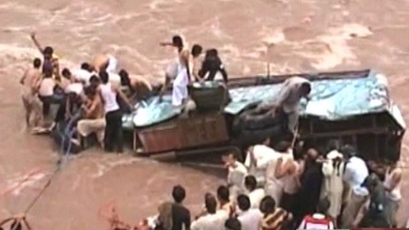
More rain lashes Pakistan, deepening flood crisis

More rain lashes Pakistan, deepening flood crisis


SUKKUR, Pakistan – More rain soaked flood-ravaged Pakistan on Saturday and even heavier downpours were forecast for coming days, deepening a crisis in which hard-line Islamists have rushed to fill gaps in the government's patchy response.

Pakistani officials estimate as many as 13 million people throughout the South Asian nation have been affected by the rising waters. About 1,500 people have died, most of them in the northwest, the hardest-hit region. Mass evacuations are under way in the southern province ofSindh after the Indus River rose there.

The intense flooding that began about two weeks ago has washed away roads, bridges and many communications lines, hampering rescue efforts. Incessant monsoon rains have grounded many helicopters trying to rescue people and ferry aid, including six choppers manned by U.S. troops on loan from Afghanistan.

The national government's response has appeared chaotic at times, and confidence in its ability to cope has been shaken by the decision of President Asif Ali Zardari to visit France and England amid the crisis.

Floodwaters receded somewhat Friday in the northwest, but downpours in the evening and early Saturday again swelled rivers and streams. Pakistani meteorologist Farooq Dar said heavy rains in Afghanistan were expected to make things even worse over the next 36 hours as the bloated Kabul River surged into Pakistan's northwest.

That will likely mean more woes for Punjab and Sindh provinces as well, as new river torrents flow east and south.

Authorities have given varying tolls for the number of people among Pakistan's 175 million impacted by the floods.

The United Nations said 4 million people had been affected, including 1.5 million severely, meaning their homes had been damaged or destroyed. But Pakistani officials have put the figure much higher.

In the northwest and Punjab, floods have displaced 12 million people, said Amal Masud, an official with the National Disaster Management Authority. In Sindh province, about 1 million people have been evacuated or are currently being helped out of their homes, said Jam Saifullah, the provincial irrigation minister.

An Associated Press reporter saw many people walking on foot and using trucks to migrate to safer places in Sindh. Some, however, refused to leave their lands, crops and homes.

"Let the flood come. We will live and die here," said Dur Mohammed, 75, who lives in a mud brick home in Dadli village.

Mohammed was one of 250 people in Dadli resisting evacuation, even though floodwaters have already began touching the embankments of the Indus River less than one mile (two kilometers) away. Many feared that if they left and the floods never came, their household items would be stolen.

The United Nations said the disaster was "on a par" with the 2005 Kashmir earthquake — which killed about 73,000 people — in terms of the numbers of people needing assistance and damage to infrastructure.

Some 30,000 Pakistani soldiers are rebuilding bridges, delivering food and setting up relief camps in the northwest, which is the main battleground in the fight against al-Qaida and the Taliban. Foreign countries and the United Nations have donated millions of dollars.

The U.S. has tapped soldiers from its war effort in Afghanistan to operate four Chinook and two Black Hawk helicopters to evacuate people from the northwest's Swat Valley and carry aid there. Around 85 U.S. soldiers are involved, though the rain has limited their flights.

Also helping in the relief effort are Islamist charities, including the Falah-e-Insaniat Foundation, which Western officials believe is linked to Lashkar-e-Taiba. Lashkar is the militant group blamed for the 2008 attacks in Mumbai, the financial capital of India, Pakistan's regional archrival.

The Falah-e-Insaniat Foundation says it is running 12 medical facilities, providing cooked food for 100,000 people every day, and plans to open shelters soon.

"The magnitude of this tragedy is so severe, and the area affected is so vast, that the government alone cannot meet the needs of such a large number of affectees," said Atique Chauhan, a spokesman for the foundation. "The U.S. efforts for rescue and relief are good, and we will appreciate help from all of humanity, whether it is the U.S. or even India."

Prime Minister Yousuf Raza Gilani appealed for national unity during the crisis.

"I request that all the political parties be united and work together to help the flood victims," he told reporters on Saturday, adding that the government is doing everything it can to move people to safer ground.

"The next two days are very critical in this regard," Gilani said. "Our top priority is to rescue people, to save their lives. But we will also provide them all facilities, and we will work for their rehabilitation."

___

Ahmed reported from Islamabad.

http://news.yahoo.com/s/ap/20100807/ap_on_re_as/as_pakistan_floods

Rabu, 16 Juni 2010

Wow! Jets Punch Holes in Clouds and Create Rain

Wow! Jets Punch Holes in Clouds and Create Rain

Cloud with hole. (Getty Images)

Aircraft can accidentally punch holes in clouds, leaving a trail of snow or rain in their wake, a new study finds.

Turboprop and jet aircraft that climb or descend under certain atmospheric conditions can inadvertently trigger what's known as cloud seeding. This technology is usually associated with schemes to control the weather. However, cloud seeding can happen by accident as planes soaring through mid-level clouds leave behind odd-shaped holes or channels in the clouds and cause narrow bands of snow or rain to develop and fall to the ground.

Holes punched in clouds are a phenomenon that has been recognized for many years and seen in photosfrom around the world. A front-page feature on Yahoo! carried the headline "A Halo over Moscow" after photos emerged of just such a hole in October 2009.

The secret behind these mysterious clouds has now been revealed: Supercooled water droplets that remain liquid even at subfreezing temperatures - below about 5 degrees Fahrenheit (minus 15 degrees Celsius). When an airplane cuts through clouds containing the supercooled water droplets, air is cooled behind aircraftpropellers or over jet wings, and these water droplets freeze and drop toward Earth.

"Any time aircraft fly through these specific conditions, they are altering the clouds in a way that can result in enhanced precipitation nearby," said study co-author Andrew Heymsfield of the National Center for Atmospheric Research (NCAR) in Boulder, Colo.

Hole-punched clouds and accidental cloud seeding may be more common in regions such as the Pacific Northwest and western Europe where cloud layers with supercooled droplets are more common, Heymsfield said.

Speculation on the how the cloud holes formed dates back to the 1940s. Aviation-related hypotheses ranged from acoustic shock waves produced by jets, to local warming of the air along a jet's path, to the formation of ice along jet contrails.

To unravel the mystery, Heymsfield and his colleagues set to the skies with a battery of instruments in tow. When they flew through some falling snow west of Denver International Airport in 2007, the research team did not notice anything unusual at the time. Once on the ground, a closer analysis of their data revealed a few peculiar anomalies.

Ground-based radar revealed an unusual echo in the area, indicating that the snow had evolved quickly and was unusually shaped. Also, the aircraft's camera recorded a hole in an otherwise solid deck of altocumulus clouds, as well as a burst of snow extending to the ground.

The final piece of the puzzle came when the researchers scrutinized the snowflakes within the snow beneath the hole-punch. These plate-shaped crystals showed evidence of what's known as riming - the accumulation of liquid water - whereas ice particles elsewhere in the cloud showed little or no riming." This tells us that the aircraft literally 'seeded' the cloud just by flying through it," Heymsfield said.

"You wouldn't necessarily see it from satellite or from the ground. I had no idea this was happening. I was sitting in back of the plane. And then this data set just fell in our laps. It was a lucky break," Heymsfield added.

The study will be published in the June edition of the Bulletin of the American Meteorological Society.

LiveScience.com chronicles the daily advances and innovations made in science and technology. We take on the misconceptions that often pop up around scientific discoveries and deliver short, provocative explanations with a certain wit and style. Check out our science videos, Trivia & Quizzes and Top 10s. Join our communityto debate hot-button issues like stem cells, climate change and evolution. You can also sign up for freenewsletters, register for RSS feeds and get cool gadgets at the LiveScience Store.

http://news.yahoo.com/s/livescience/20100614/sc_livescience/wowjetspunchholesincloudsandcreaterain