Tampilkan postingan dengan label Volcanic ash. Tampilkan semua postingan

Senin, 17 Mei 2010

Most European airports reopen, some see ash delays

Most European airports reopen, some see ash delays


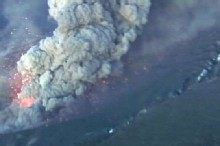
Volcanic ash grounds 1,000 European flightsReuters – A fresh cloud of ash rises from the volcano under the Eyjafjallajokull glacier in Iceland May 16, 2010. …

LONDON – Three of Europe's busiest airports reopened Monday afternoon after a dense volcanic ash cloud from Iceland dissipated and a no-fly zone was lifted. Up to 1,000 flights in Europe were affected by the closures.

Flights were landing and taking off from London's Heathrow andGatwick airports and Amsterdam's Schiphol Airport, but all three warned travelers it would take time for airlines to clear the backlog of delayed flights and to contact their airlines before going to the airport.

Eurocontrol, the continent's air traffic control agency, said 28,000 flights were expected Monday in Europe, about 1,000 less than normal, mainly due to the disruptions in Britain and the Netherlands.

Icelandic civil protection official Agust Gunnar Gylfason said the ash cloud was traveling to the north, forcing airports in Keflavik andReykjavik to close. He said seismic activity at the volcano was unchanged.

All British, Scottish and Irish airspace was open at least until early Tuesday, but airspace over the North Sea was still restricted, affecting some helicopter operations.

British Airways chief executive Willie Walsh — facing a fresh wave of strikes by cabin crews on Tuesday — called the latest airspace closures "a gross overreaction to a very minor risk."

"I am very concerned that we have decisions on opening and closing of airports based on a theoretical model," he said. "There was no evidence of ash in the skies over London today yet Heathrow was closed."

Aviation officials have defended the decision to impose the no-fly zone, saying airline representatives and engine manufacturers last week had agreed to find a way to ensure planes could fly safely in the volcanic ash.

Britain's transportation minister, Philip Hammond, said aircraft manufacturers were examining evidence to see "what inspection regimes they can put in place that would allow safe flying through a somewhat higher threshold of ash.

"If we can do that, the likelihood of volcanic ash disrupting flights will obviously diminish," he said.

Germany sent up two test flights Sunday to measure the ash cloud, but there was no word yet on the results of those tests. Still, Germany said Monday the latest ash cloud should not affect its airports.

"At this time, the concentration of ash above German air space is so low that there are no reductions in air traffic," German Air Traffic Controllers said.

Ash can clog jet engines. The April 14 eruption at Iceland's Eyjafjallajokul volcano forced most countries in northern Europe to shut their airspace between April 15-20, grounding more than 100,000 flights and an estimated 10 million travelers worldwide. The shutdown cost airlines more than $2 billion.

Last week, the European air safety agency proposed drastically narrowing the continent's no-fly zone because of volcanic ash to one similar to that used in the U.S. The proposal still must be approved.

Eurostar added four extra trains Monday — an additional 3,500 seats — between London and Paris to help travelers cope.

Eyjafjallajokul (pronounced ay-yah-FYAH-lah-yer-kuhl) erupted in April for the first time in nearly two centuries. During its last eruption, starting in 1821, its emissions rumbled on for two years.

__

Associated Press writers Slobodan Lekic in Brussels, Jan Olsen in Copenhagen, Melissa Eddy in Berlin and Mike Corder in The Hague, Netherlands, contributed to this report.

http://news.yahoo.com/s/ap/20100517/ap_on_bi_ge/eu_iceland_volcano;_ylt=AhczMpRtIeZqobilyjGqdfv9xg8F;_ylu=X3oDMTM3ZW4yZnMxBGFzc2V0A2FwLzIwMTAwNTE3L2V1X2ljZWxhbmRfdm9sY2FubwRjY29kZQNtb3N0cG9wdWxhcgRjcG9zAzYEcG9zAzYEc2VjA3luX3RvcF9zdG9yaWVzBHNsawNtb3N0ZXVyb3BlYW4-

Volcanic ash closes London's Heathrow airport

Volcanic ash closes London's Heathrow airport


EUROPE ASH CLOUDAP – Map shows the ash cloud over Europe from the volcano in Iceland

LONDON – Two of Europe's busiest airports closed early Monday morning as a dense cloud of volcanic ash drifted from Iceland, aviation authorities said.

The airspace over London's Heathrow Airport closed at 1 a.m. local time Monday (0000 GMT; 8 p.m. EDT), Britain's National Air Traffic Service said in a statement late Sunday night.

In Amsterdam, Schiphol Airport, another of Europe's biggest air travel hubs, was closed until 2 p.m. local time Monday, a statement on Dutch airline KLM's website said.

The restrictions affecting Heathrow — as well as Gatwick, Stanstedand London City airports — will be in place until at least 7 a.m. local time (0600 GMT) Monday, the aviation authority said.

Airports across Britain and Ireland were closed for much of Sunday because of the drifting ash. The shifting of the no-fly zone southward will allow airports in northern England — including the key cities ofManchester and Liverpool — to reopen after 1 a.m. local time.

But all airports in Northern Ireland, as well as some Scottish facilities, will remain shut.

In Ireland, Dublin's international airport closed early Sunday evening until at least 12 p.m. Monday (1100 GMT, 7 a.m. EDT). Some airports in Ireland's west were closed and will reopen at different times Monday, but Shannon and southern Cork were open "until further notice."

The British air traffic agency said the ash cloud was changing shape and moving south, toward Oxford, England, 60 miles (100 kilometers) northwest of London. Britain's weather service says the northwest winds should shift midweek, redirecting the ash away from Britain.

German authorities sent up two test flights Sunday to measure the ash cloud, one from the German Aerospace Center (DLR) and the other from Lufthansa, the country's biggest airline.

The DLR plane flew to southern England then continued north, collecting data from between 10,000 to 23,000 feet (3,000 to 7,000 meters). The Lufthansa Airbus A340-600, equipped with special scientific gear, left Frankfurt to fly over northern Germany, the United Kingdom and parts of Scandinavia.

All the data from both flights was immediately sent to aviation authorities in the U.K, the Netherlands and Germany, said aerospace center spokesman Andreas Schuetz.

Ash can clog jet engines. The April 14 eruption at Iceland's Eyjafjallajokul volcano forced most countries in northern Europe to shut their airspace between April 15-20, grounding more than 100,000 flights and an estimated 10 million travelers worldwide. The shutdown cost airlines more than $2 billion.

In southern Iceland, activity at the volcano fluctuated Sunday but did not get more intense, civil protection official Agust Gunnar Gylfason said. He blamed the closures on shifting winds.

"What really changes the situation is the weather pattern," he said.

The Icelandic weather service said "presently there are no indications that the eruption is about to end."

Airlines complained bitterly over the air space closures last month, calling them an overreaction. The European air safety agency last week proposed drastically narrowing the continent's no-fly zone because ofvolcanic ash to 120 miles (190 kilometers) like the one used in the U.S. The proposal still must be approved.

Virgin Atlantic's president, Sir Richard Branson, criticized British authorities for Sunday's no-fly zone. British Airways agreed, calling the approach "overly restrictive and not justified on safety grounds" and saying airlines are best qualified to determine whether it's safe to fly.

"The closing of Manchester airspace once again is beyond a joke," Branson said in a statement. He said test flights have "shown no evidence that airlines could not continue to fly completely safely."

A spokesman for Britain's Civil Aviation Authority called Branson's remarks "surprising" because airline representatives and engine manufacturers last week had agreed to find a way to ensure planes could fly safely in the volcanic ash.

"We as an organization can't just say, 'Oh, I'm sure it's all right, go fly without evidence it's safe,'" Jonathan Nicholson said.

British Airways, facing cabin crew strikes beginning Tuesday, said it had canceled a small number of flights out of Manchester. The airline's chief executive, Willie Walsh, is to meet with British Transport Secretary Philip Hammond on Monday.

Eurostar, which runs trains between Britain and continental Europe, said it was adding four extra trains — an additional 3,500 seats — between London and Paris on Monday.

Eyjafjallajokul (pronounced ay-yah-FYAH-lah-yer-kuhl) erupted in April for the first time in nearly two centuries. During its last eruption, starting in 1821, its emissions rumbled on for two years.

__

Associated Press writer Juergen Baetz contributed to this story from Berlin.

http://news.yahoo.com/s/ap/20100517/ap_on_bi_ge/eu_iceland_volcano

Sabtu, 15 Mei 2010

UK, Germany eye possible ash travel disruptions

UK, Germany eye possible ash travel disruptions


This image provided by NASA shows the plume of ash from Iceland’s Eyjafjallajökull volcano, reaching a height of four to five kilometers (13,000-17AP – This image provided by NASA shows the plume of ash from Iceland’s Eyjafjallajökull volcano, reaching …

LONDON – Volcanic ash from Iceland could disrupt air travel in bothBritain and Germany in the next few days, officials said Saturday.

The British Department of Transport said there was a risk that parts of British airspace could be closed beginning Sunday and those problems could continue through Tuesday. The predictions are based on the continuing eruption of Iceland's Eyjafjallajokul volcano and current wind and weather conditions.

German air traffic control spokesman Axel Raab told The Associated Press that German air travel could see possible disruptions starting Monday. He cautioned, however, that indicators were still "very, very vague."

Germany will send up a test flight Sunday to measure the ash concentration, German Aerospace Center spokesman Andreas Schuetz said. Any decision on air space closures will be made after that flight and Sunday's weather forecasts, said Raab.

A spokeswoman for Lufthansa, Germany's biggest airline, Stefanie Stotz, welcomed the test flight and stressed that the situation so far didn't seem dramatic.

The Met Office, Britain's weather forecaster, said Saturday the wind is expected to change direction Tuesday, which would lower the risks of travel disruptions.

Transport secretary Philip Hammond said five-day forecasts are now being published to give airlines and travelers "the best possible information. However, he said the situation "remains fluid and these forecasts are always liable to change."

http://news.yahoo.com/s/ap/20100515/ap_on_bi_ge/eu_iceland_volcano;_ylt=Aqm6WcOKBePSuuD1xhVHvzZvaA8F;_ylu=X3oDMTJqMmZjc3NoBGFzc2V0A2FwLzIwMTAwNTE1L2V1X2ljZWxhbmRfdm9sY2FubwRjcG9zAzEEcG9zAzIEc2VjA3luX3RvcF9zdG9yeQRzbGsDdWtleWVzcG9zc2li

Kamis, 22 April 2010

Airspace in Norway and Sweden shuts again

Airspace in Norway and Sweden shuts again


A passenger waits in line at the Lufthansa counter to check into a flight scheduled to leave for Europe at Los Angeles International Airport on WednesAP – A passenger waits in line at the Lufthansa counter to check into a flight scheduled to leave for Europe …

BRUSSELS – Aviation authorities say they have closed the airspace over parts of Norway and Sweden as shifting winds send a new cloud of volcanic ash over Scandinavia.

The Swedish aviation authority says airspace is still open over the capital Stockholm, but closed over the southern cities of Goteborg and Malmo, and large parts of western and northern Sweden.

Authority spokesman Bjorn Stenberg says changing winds meant the ash cloud over Sweden didn't disperse as forecast. Meanwhile, new ash clouds are blowing in over western Norway.

Norwegian authorities say Oslo remains open but airspace over western Norway has closed again, including Stavanger and Bergen.

Eurocontrol says it expects nearly 22,000 flights over Europe on Thursday.

http://news.yahoo.com/s/ap/20100422/ap_on_bi_ge/eu_iceland_volcano

Senin, 19 April 2010

Volcanic ash relentless as tremors rock Iceland


April 18, 2010

Volcanic ash relentless as tremors rock Iceland

Reuters

Volcanic ash relentless as tremors rock Iceland Lava flows from a volcano in Eyjafjallajokul April 17, 2010. REUTERS/Lucas Jackson

By Omar Valdimarsson

REYKJAVIK (Reuters) - Powerful tremors from an Icelandic volcano that has been a menace for travelers across Europe shook the countryside on Sunday as eruptions hurled a steady stream of ash into the sky.

Ash from the volcano drifted southeast toward the European continent, sparing the capital Reykjavik and other more populated centres but forcing farmers and their livestock indoors as a blanket of ash fell on the surrounding areas.

"We are all doing our utmost to make sure that the farming community in this area survives this disaster," Icelandic President Olafur Grimsson told Reuters Television.

He said it was difficult to assess the impact on tourism in the country, which is only just emerging from a deep recession, but that recent events had put Iceland in the spotlight and that the country might even lure in more visitors.

"What we are experiencing here in Iceland is forces of nature on display... And that is a spectacle -- the combination of volcanic eruption and glaciers you cannot see anywhere else in the world," he said.

Iceland's Meterological Office said tremors from the volcano had grown more intense but that the column of ash rising from the volcano had eased back to 4-5 km (2.5-3 miles) from as high as 11 km when it started erupting earlier this week.

"We are seeing mixed signals. There are some hints that the eruption will be decreasing, and others that show it is not decreasing," said Einar Kjartansson, a geophysicist at the Meteorological Office.

The eruption is taking place under Iceland's Eyjafjallajokull glacier, normally a popular hiking ground about 120 km (75 miles) southeast of the capital Reykjavik.

Kjartansson believes the volcano has melted about 10 percent of the glacier, but melting might have slowed in recent hours.

However, that does not mean Europe will see any great relief from the plume of ash that is choking the upper atmosphere with tiny particles of glass and pulverized rock, threatening jet engines and airframes.

The glacier on top of the volcano is about 200 meters (650 ft) thick -- thinner than many glaciers atop other volcanoes that have erupted in recent times. That means there is less ice, and water, to suffocate the eruptions and resulting steam.

"It might mean more intense ash production," Kjartansson said.

It still could take months for the volcano to burn through the rest of the glacier, to a point where the steam and ash would turn instead into lava, he said.

DAY TURNS TO NIGHT Vidir Reynisson, of the Civil Protection Department, said some areas near the volcano were pitchblack during daylight hours.

"There are places where you can't even see the palm of your hand," he said.

Many farmers remained to tend their livestock and some, assisted by rescue squads, were on rooftops sweeping off the accumulated ash to prevent roofs from caving in. There were no disruptions to electricity or water supplies in the area.

Meanwhile, travelers stranded in Iceland due to limited flights out of the international Keflavik airport got approval on travel to Norway.

Icelandair said it was running five flights to Trondheim in Norway with a total of 800 passengers while Iceland Express flew once. Flights to and from the United States remained unaffected.

But more delays and diversions could be in store for Europe.

U.S.-based forecaster AccuWeather said winds at the level of the ash plume were expected to continue steering it from Iceland into northern Britain and southern Scandinavia through Monday.

The winds are seen shifting farther south Tuesday and Wednesday, sending any ash farther south and putting Germany and the Netherlands at greater risk, it said.

Iceland sits on a volcanic hotspot in the Mid-Atlantic Ridge and has relatively frequent eruptions, though most occur in sparsely populated areas and pose little danger to people or property. The last eruption took place in 2004.

(Writing and additional reporting by Mia Shanley in Stockholm, editing by Dominic Evans)


http://www.scientificamerican.com/article.cfm?id=volcanic-ash-relentless