LIBBY, Mont. – Gayla Benefield and Eva Thomson are sisters who have grown used to death. For two decades, they have watchedasbestos from a nearby vermiculite mine strangle their parents, Thomson's husband, an aunt, several in-laws and numerous neighbors and friends.
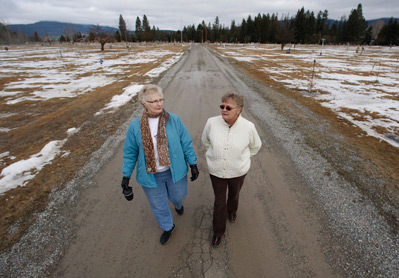
So as they wandered the Libby cemetery on a blustery Montana morning, they worked the graves like a block party — retelling old stories and commiserating with the dead.
Talk turned to their own fates.
Both sisters suffer from the microscopic asbestos fibers lodged deep in their lungs. Their breathing is sometimes choked by plaque building up around the fibers. If it progresses into cancerous mesothelioma, they face certain death.
"If you're lucky, you get hit by a truck and you go quickly," Benefield said, her face betraying no emotion but her voice tight with anger.
The sisters' town, Libby, population 3,000 along the Kootenai River, has emerged as the deadliest Superfund site in the nation's history.
Health workers tracking Libby's plight estimate at least 400 people have died of asbestos-related illnesses — from W.R. Grace mine workers and family members who breathed in the dust they brought home in their clothes, to those who played as kids in waste piles dumped by the company behind the community baseball field. Some 1,500 locals and others who were exposed have chest X-rays revealing the faint, cloudy shadows of asbestos scarring on their lungs.
Even though research long showed cause for concern — up to 70 percent of miners in a 1980s study had fibers in their lungs — it took news reports about the deaths to drive officials to action, beginning a decade ago. After the cleanup began, the U.S. Environmental Protection Agency confidently predicted it would be done in two years at a cost of $5.8 million. Ten years on, the price tag has exceeded $333 million, the deaths continue, and more asbestos keeps showing up — in schools, in businesses, in hundreds of houses.
The scope of contamination has at times overwhelmed environmental regulators, dragging out the cleanup, an Associated Press review of hundreds of pages of government documents and interviews with current and former agency officials revealed.
News cameras returned to Libby last June, when new EPA chief Lisa Jackson declared a health emergency, a step the agency rejected during the Bush administration.
New patients continue to file into the local clinic to be diagnosed with asbestos illnesses at the rate of 15 to 20 a month. Because of a decades-long latency period, such diagnoses are expected for at least another 10 years.
The EPA this month took its first step toward wrapping up its efforts over the next two to three years, rekindling anxieties.
"Everybody wants Libby to go away and it's not going away," said Dr. Brad Black, director of Libby's Center for Asbestos Related Diseases. His stethoscope pressed against the back of a 36-year-old patient who never worked in the mine, Black said the man's exposure likely came from playing in a friend's contaminated house as a child.
Some scientists say the threat will exist as long as people remain in Libby — and the notion of moving the whole town has been floated by an attorney for a citizens' group. But just as some residents maintained a fierce loyalty to W.R. Grace even as fatal asbestos illness spread, the idea of moving now is quickly discarded.
"People say, 'Why don't you leave Libby?'" Benefield said. "I've got the fiber in me. That won't make the problem go away. Not at all."
___
The unfolding tragedy, with moonsuited contractors carting off contaminated materials as locals go about their business, seems odd and out of place in Libby, where the snowcapped Cabinet Mountains tower over the lush Kootenai Valley as it winds its way toward Idaho.
Established in the 1800s as a mining and fur trading outpost, the town retains its frontier feel. Locals call it "God's Corner."
W.R. Grace bought the vermiculite operation in 1963 and at the mine's peak in the l970s, Grace produced almost 2 million tons of ore annually and employed about 200 miners and others. Vermiculite stripped from the terraced steps carved into Zonolite Mountain was shipped around the world to make insulation.
But unmarketable material — much of it asbestos — made up about 80 percent of the ore. Crushing the rock to remove "nuisance" materials set billions of asbestos fibers loose in clouds of dust that drifted the six miles down to Libby, leaving a powdery trace as light as snow.
If it looked benign, many warnings cried out that it was not. In 1964, workers appealed to the state Board of Health to help clean up the unhealthy conditions. In 1978, word of the problems caused by asbestos from Libby's mine reached the EPA. In 1981, a Grace scientist found that runners on the high school track likely were stirring up dangerous levels of asbestos.
Little was done — despite state-issued orders for the mine to cut down on dust levels and to upgrade filtering equipment. Federal regulators stayed on the sidelines, and the mine remained open until 1990.
Nine years later, EPA finally joined the fray — after the Seattle Post-Intelligencer newspaper detailed the toll of dead and dying that had become too large to ignore.
Grace, which declared bankruptcy in 2001, waged an eight-year court battle to limit its cleanup responsibilities. That ended with a 2008 settlement under which the company paid EPA $250 million.
"They settled the lawsuit," Grace spokesman Greg Euston said. "They are not interested in talking about Libby anymore."
At the cemetery, Benefield and Thomson paused before the grave of their mother, Margaret Vatland — the first non-mine worker whose death was traced to Libby asbestos. Standing before the marker, Benefield promised her mother she'd come back soon to scrub it clean.
Vatland cared for their father for years until he died from asbestos exposure in 1974; she was diagnosed a decade later. By the time she died, in 1996, her lungs had shriveled "until they looked like two sausages hanging on a stick," Benefield said.
___
Since the EPA arrived in 1999, the agency has overseen cleanup work on more than 1,250 homes and businesses.
That includes the removal of 70,000 truckloads of contaminated soil — including from yards where, unaware of the danger years ago, homeowners had tilled vermiculite waste into their gardens. Crews removed waste piles where kids, marveling at how fluffy the material was, how it sparkled in the sun, used to go sliding.
But the cleanup terms have changed repeatedly.
Initially, houses were to be cleaned entirely of asbestos-loaded vermiculite. Two years into the project, the EPA narrowed the effort only to attics.
For the yards around the homes, the EPA at first cleaned up only high-use areas such as swing sets, driveways, gardens. In 2006 that was reversed, and soil is now removed and replaced wherever significant levels of vermiculite are found. The change means the EPA will have to revisit 850 homes for possible additional work.
Last year, Libby's roads and highways were tacked onto the cleanup.
Two EPA Inspector General reports, in 2002 and 2006, faulted agency administrators for delays in the baseline scientific risk assessment that typically guides Superfund cleanups. The risk assessment remains incomplete.
Moving forward without the assessment leaves the EPA no way to know when Libby is safe, said Richard Troast, a former EPA toxicologist based in Washington, D.C. who worked on the Libby cleanup for five years. He said staff scientists had been pushing for the assessment since 2001 but their efforts were hampered by senior agency officials.
___
Moving among the headstones at the cemetery, Benefield and Thomson stopped at the marker for Les Skramstad, a former miner who struggled with Benefield to raise the alarm about Libby when no one wanted to listen. "This was the sidekick here," Benefield said to Skramstad's grave. "I'd kick ass, Les would take names."
Benefield said one of Skramstad's granddaughters visited his grave prior to school plays to give him exclusive preview performances.
Buried next to Skramstad is his son, Brent, an Army veteran, logger and musician — "born with a guitar in his hands," according to his obituary. He was 51 years old when he died last year of cancer believed related toasbestos exposure.
EPA and Montana environmental officials say that because of their efforts, the air in Libby and the surrounding area is cleaner today.
"What we want to do on the ground will effectively break the exposure pathway," said EPA spokesman Ted Linnert. "It can be the most toxic thing on earth, but no one can be exposed to it."
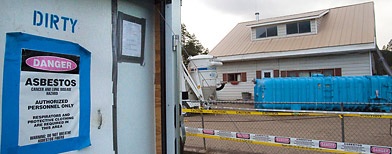
But the asbestos isn't gone. It lingers behind kitchen walls in the modest houses lining Libby's quiet back streets, just beneath the surface of backyards, at the town park, where a small "No Trespassing" sign is all that separates a picnic area from contaminated ground.
It's also in the trees — tens of thousands of acres of ponderosa pine, larch and lodgepole pine that blanket the surrounding mountain landscape. Logging was long the community's lifeblood, centered at the 1,200-worker Stimson mill, shuttered in 2006 after the forestry industry contracted.
Loggers who worked the area when the mine and mill were active tell stories of dust plumes rising from felled trees. Over time, scientists say, countless asbestos fibers buried themselves in the bark.
Along the BNSF railroad line — used to ship vermiculite in open ore cars to Grace processing plants across the country — University of Montana researchers have tallied trees with 19 million fibers per gram of bark. One tree close to the mine has more than 500 million fibers per gram.
Still, when asbestos worries first arose, Grace workers who eventually became sick were among the company's fiercest defenders.
City Councilman D.C. Orr, who worked as a contractor at the mine for almost two decades, recalls joining with others at the mine to eat raw vermiculite as a way to mock the health concerns raised by activists likeBenefield.
When Grace instituted a smoking ban, union bosses representing miners protested and brought the matter to arbitration. They lost. Only years later was it revealed that Grace knew smoking and asbestos made for a particularly deadly combination.
There is a still a modicum of company-town mentality in Libby. Merchants argue that asbestos isn't the only thing killing the town; they talk about the blow the economy took when the EPA first showed up and sparked a media frenzy, then when Jackson arrived last year.
Tucked among the closed-down storefronts now lining Mineral Avenue in downtown Libby are a scattering of stubborn businesses that hung on through the mine and mill closings, the asbestos revelations, the recession.
"If you want, we can go lie down in the street for you and pretend to be dead," Gary Njirich, owner of the Libby Cafe, sarcastically told a reporter.
Njirich, a stocky, 68-year-old former cop, and his wife came to Libby from Nevada in 1994, to run the cafe until they retired. Now they can't sell it.
Sitting at an empty table at the close of another slow day, Njirich gestured toward the quiet street outside the cafe's bay windows and blamed a hyped-up image of Libby as a death trap. "There has to be some point and rationale where we say we're going to live with this," he said.
___
Stories of the living and the dead intertwine for Benefield and Thomson, who have been to the cemetery so often over the years. To them it's all one community, with some folks above ground, some below.
Thomson chuckled as she pointed to another asbestos victim's grave. Divorced, he ended up buried between his two deceased mothers-in-law for all eternity.
Benefield, a former bartender and truck driver, said she's been to four asbestos-related funerals so far this year and has started making preparations for her own burial. So has Thomson, who bought a plot alongside her deceased husband, Dale, a supervisor for Grace who died at age 61 in 1992.
No one has gone to jail for what happened in Libby.
Several Grace executives were prosecuted on charges of covering up the asbestos danger. But they were found not guilty last fall. U.S. District Judge Donald Molloy ruled many internal memos and other documents that suggested Grace's culpability could not be used as evidence because some were decades old.
In 1998, Benefield and Thomson won the first court victory for secondary asbestos exposure against Grace, a $250,000 civil award for the death of their mother. That triumph has long since been overshadowed by loss.
Benefield said every adult member of her family more than 47 years old has been diagnosed with asbestos scarring. The latest, her older daughter, got the news in February.
After looping through the cemetery, its long rows of well-tended graves broken periodically by freshly turned earth, Benefield and Thomson walked back to their mother's grave.
Crows in nearby trees cawed incessantly as the sisters considered what has happened here since the EPA arrived.
"After 10 years, how far have we come?" Benefield asked. "We've removed a lot of material. We've buried a lot of people. My God, it's a nightmare."
___
Matthew Brown is an Associated Press staff writer based in Billings, Mont. He can be reached at features(at)ap.org.
http://news.yahoo.com/s/ap/20100524/ap_on_he_me/us_asbestos_town_2