Tampilkan postingan dengan label floods. Tampilkan semua postingan

Rabu, 05 Januari 2011

Australian city cut off by floods braces for more

Australian city cut off by floods braces for more


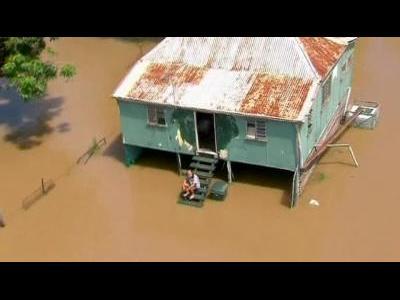
Snakes, crocodiles threaten flood-hit Australia townAFP – The appropriately named 'Swamp Store' is flooded along with much of the Australian town of Rockhampton …

ROCKHAMPTON, Australia – Floods that have cut air, rail and road links to an Australian coastal city are now threatening its sewage plant, and waters are still expected to rise another few feet before peaking Wednesday.

Residents of Rockhampton made their way in boats through waters that reached waist-high in some areas Tuesday but were warned not to wade into the them since snakes and crocodiles could be lurking.

A huge inland sea spawned by more than a week of heavy rain across Queensland state is making its way along the Fitzroy River toward the ocean — and Rockhampton lies in the way. As waters drain, the city of 75,000 people is expected to see flood levels rise another few feet (half-meter) by Wednesday.

The river has already burst its banks, inundating houses and businesses in waters ranging from a few inches (centimeters) to waist-deep. Up to 500 people who live along the river have evacuated their homes. Air and rail links to the city were cut and only one main road remained open.

Rockhampton Mayor Brad Carter said Tuesday that large swaths of the city might be under water for another two weeks.

Adding to the woes, Carter said Tuesday the floodwaters were threatening Rockhampton's sewage treatment plants and officials may seek to discharge some effluent directly into the swollen river system. He said this would only occur away from the city, and that the discharged sewage would be highly diluted and would not pose a health risk.

Rockhampton is the latest of 22 cities and towns in Queensland to be swamped by floods that began building just before Christmas — the worst effects of an unusually wet summer in the tropical region. No one has died in Rockhampton, but swollen rivers and flooding have killed 10 people in Queensland since late November, police say.

Officials have said the flooded area covers the size of France and Germany combined and 200,000 people have been affected. U.S. Secretary of State Hillary Clinton sent a condolence message and said Washington was ready to help if needed.

"Our thoughts and prayers are with everyone affected by these floods, especially the families of the victims, and with all the people of Australia," Clinton said in a statement distributed by consular officials.

Wendy White, who owns a clothing alterations shop in Rockhampton, said she was worried about her merchandise and equipment as the waters rise.

"We've taken everything about two feet up off the floor ... my machines are above that and then everything, all my stock is stacked on that," she told Australian Broadcasting Corp. "So it'd be a case of, if the water does come in, we'll have to mop up before we can set up to start trading again."

Authorities have warned residents to stay out of floodwaters for their own safety, saying the biggest risk is from fast-moving currents powerful enough to sweep cars from roadways. At least two people have drowned after being swept away in their cars.

Mayor Carter has also said residents have reported seeing higher than usual numbers of snakes, as the animals move around looking for dry ground. He has also noted that saltwater crocodiles have been spotted from time to time in the Fitzroy River.

"We do not think they are a risk to public safety if people keep out of the waters, but if people do enter the waters their safety cannot be guaranteed," Carter told The Australian newspaper.

Animal welfare worker Wendy Hilcher said fears about snakes and crocodiles were hampering her group's efforts to rescue pets left behind by people who had left their homes in flooded areas of the city.

"It's not just the safety aspect of getting to these places, it's what's in the water itself," said Hilcher, from the Royal Society for the Prevention of Cruelty to Animals. "If it gets too dangerous, we have to get out of there."

A military cargo plane landed in a city north of Rockhampton on Monday carrying food, water, medical supplies and other items such as diapers to keep the city stocked with necessities. The goods were trucked south to the city, or carried on barges. Further flights would continue as needed, acting Defense Minister Warren Snowdon said. Two navy helicopters were on standby to help.

Other supplies were being brought by sea from areas south of Rockhampton, where regular supply routes may be closed for days to come.

Many stores and businesses in dry parts of the city remained open. Power supplies were being severed to inundated areas for safety reasons, officials said.

Prime Minister Julia Gillard has said the cost associated with the flooding will likely reach many hundreds of millions of dollars, and has announced relief funding worth millions.

Rains have eased, and water levels have been dropping in some towns in Queensland. Across the state, some 1,000 people are living in evacuation centers, and it may be a month before the floodwaters dry up completely.

http://news.yahoo.com/s/ap/20110104/ap_on_re_as/as_australia_flooding

Rabu, 03 November 2010

FLASH FLOODS Hat Yai reeling

FLASH FLOODS

Hat Yai reeling


Relief workers swamped by flood 'worse than 2000'; 7 other provinces in South also battling storm disaster


A large number of residents were stuck in their flooded homes, as reported in news coverage or relayed messages for help via Facebook and Twitter, with tap water, electricity and land-line telephones cut off. In one case a woman in labour was trapped in her home and could not get to a hospital.
Despite relief efforts pouring in, heavily flooded Hat Yai district in Songkhla province remains in crisis, with high flood waters in urban areas and widespread effects reported in the outskirts.


Nearly 600 patients, including 15 in intensive care, have been evacuated from Hat Yai Hospital to Prince Songkhla Hospital by a joint Naval and Army operation, a government flood relief centre said. Many residents refuse to be evacuated, citing worries over their belongings, including theft.

The Information and Communications Technology Ministry reported damage to 80 of its 200 towers after generators attached to them were flooded. A number of mobile satellite signal units have been sent to the area to bridge the missing links and normal mobile service was expected by yesterday evening.

The volume of flood water volume streaming into the business district has reached 250 million cubic metres, a record volume overtaking those documented in 1988 and 2000 and the worst in 70 years, according to the Royal Irrigation Department.

There have been no official figures on flood damage but an initial estimate, from Hat Yai Mayor Phrai Phatthana, cited 80 per cent of urban areas and 30,000 households affected, and 10,000 residents stranded in their homes.

A large number of cars were stuck on bridges after the flood water reached too high a level for them to go through. Many cars parked in lower sections of the bridges were inundated.

Phrai told The Nation that food shortages would be commonplace for another day and the electricity would not be available up to tonight. About 300 guests remained trapped in the Lee Garden Hotel with food supplies running out.

In tambon Khuan Lang, 400 students were trapped in a boarding school, all of them moved up to the second floors of the buildings to stay above the 2-metre flood level. About 20 staff were trapped in Diana Mall, saying they would need food supplies from today onwards.

A weather report said the storms that ravaged Songkhla had moved on to the Andaman Sea, but would still cause heavy rain in all provinces in the South from Chumphon down. Besides Songkhla, the floods are spreading to seven other provinces: Phatthalung, Surat Thani, Pattani, Satun, Trang, Yala, Narathiwat and Pattani.

Her Majesty the Queen has graciously granted rations and supplies stocked at the Thaksin Ratchaniwet Palace in Narathiwat province to be delivered to flood victims, at the initiative of His Majesty. The supplies have been packed in 5,000 survival kits for distribution.

The provincial irrigation office said flood water should subside in Hat Yai urban areas within two or three days if drainage aided by 16 large pumps continued at the current rate. But areas close to Rama I and U Tapao canals require more time because they were swollen to a high level, the agency said.

http://www.nationmultimedia.com/home/2010/11/03/national/Hat-Yai-emergency-overwhelms-flood-relief-efforts-30141413.html

Kamis, 09 September 2010

A common link among fire, floods, food riots: extreme weather

A common link among fire, floods, food riots: extreme weather

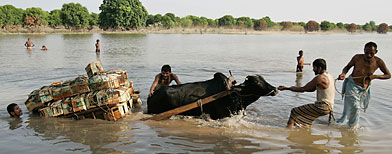
Pakistani men help a cow carrying crates of mangos cross a flooded area. (AP Photo/Aaron Favila)

Ten million without shelter in Pakistan floods: UNAFP – A young Pakistani carries a bag of aid through a flooded area in Bannay Wala. Pakistan's devastating …

By JOHN CAREY
Special to Yahoo! News

Deadly riots in the streets of Mozambique over sharply higher food prices have left 13 dead. Anger is growing in Egypt and Serbia as well. Panicked Russian shoppers have cleared the shelves of staple grains. And the devastating floods that have left as many as 10 million Pakistanis homeless are also raising concerns about the country's ability to feed itself.

A series of isolated disasters? Not at all. The common thread: extreme weather, which is putting pressure on food supplies around the globe.

What's going on?Â

For most of the summer, Russia was in the grip of an unprecedented heat wave. Fires darkened the skies of Moscow with thick smoke, and the Russian wheat crop withered and burned. Fully a third of the usual Russian harvest of buckwheat -- one of the country's most commonly used grains -- was lost. That has led to shortages of wheat at home in Russia -- and an export ban on Russian wheat.

The export cutback has in turn driven up food prices in countries like Mozambique and Egypt, which depend on food imports, sparking anger and riots.

Meanwhile, the same weather pattern of high pressure that brought searing heat to Russia diverted moisture in the atmosphere toward Pakistan, causing torrential rains and devastating flooding.

Who is affected?

Mostly, just those people in countries now facing shortages and price spikes. There's no overall shortage of food. The United Nations' Food and Agriculture Organization says that 2010 brought the third-largest harvest of grains on record, leaving global food stocks high.

But the shortfall in Russian wheat did push up grain prices. As a result, the government of Mozambique raised the official price of bread by 20%. That touched off the riots, forcing the government to backtrack.

In hard-hit Pakistan, prices of food have risen 15%.

[Related: Pakistan floods: How to help]

The Food and Agriculture Organization acknowledges that higher prices are causing hardships. But it adds that the situation now is far less dire than it was in 2007-08, when the soaring price of energy caused an even bigger spike in food prices.

Will the United States be affected?

In the short term, there are few concerns outside countries hit by natural disasters or higher prices. Even Russians aren't facing actual shortages of food, just limited supplies of one of their favorite staples -- buckwheat.

In fact, the problems have been a boon for American farmers. Exports of farm products nearly hit record levels in 2010, thanks to bountiful harvests and higher prices for wheat, corn, cotton and other crops.

How worried should we be?

Nevertheless, the long-term threat -- the potential impact of climate change on agriculture throughout the globe -- is major. Until recently, scientists were careful to say that any single natural disastrous climate event, such as the Russian drought or Hurricane Katrina, could not be attributed to global warming. No longer. "The issue isn't whether these events are natural or caused by climate change," former Energy Department official Joseph J. Romm told Yahoo! News. "It's both. You can't separate the two."

For instance, a study by Kevin Trenberth -- head of climate analysis at the National Center for AtmosphericResearch in Boulder, Colo. -- has shown that Hurricane Katrina dumped more rain on the Gulf Coast than would have happened without climate change.

"What we can say is that certain events would have been extremely unlikely to have occurred without global warming, and that includes the Russian heat wave and wildfires, and Pakistan, Chinese and Indian floods," Trenberth told Yahoo! News.

[Related: Farmer's Almanac: Global cooling to continue]

Even the Russians have become believers in the threat. The Russian government used to doubt the existence of climate change, or argue that it might be beneficial for Russia to get a bit warmer.

Now, suggests Romm, they've realized that global warming won't bring a gradual and relatively benign increase in temperatures. Instead, as scientists' climate models have long predicted, the effect will be to intensify extreme events. As Russian President Dmitri A. Medvedev told the Russian Security Council this month: "Everyone is talking about climate change now. Unfortunately, what is happening now in our central regions is evidence of this global climate change, because we have never in our history faced such weather conditions in the past."

How critical could the situation get?

If you think the Russian heat wave or Pakistan floods are bad, wait until the Earth's temperature rises a few more degrees, as scientists' models also predict. "We ain't seen nothing yet," warns Romm. "I think we can't even imagine" future events.

So agriculture -- and the world's ability to feed itself -- face huge challenges.

"We are getting to a point where we are getting more water, more rainy days, but it's more variable, so it leads to droughts and it leads to floods," Sunita Narain, the head of the Center for Science and Environment in India, told AFP during a world conference on water, being held through Saturday in Sweden. "That is leading to huge amounts of stress on agriculture and livelihoods."

What can be done to ease the problems?

When it comes to short-term problems -- shortages and high prices -- the key is to ensure that global food stocks get to the countries that most need them, agricultural experts say.

The long-term problem is far more complicated. The only real solution, many scientists believe, is to tackle global warming at its root, by reducing emissions from fossil fuels or by stepping up efforts to take carbon dioxide and other greenhouse gases out of the atmosphere.

http://news.yahoo.com/s/ynews_excl/ynews_excl_sc3564

Kamis, 12 Agustus 2010

Long, hot summer of fire, floods fits predictions

Long, hot summer of fire, floods fits predictions

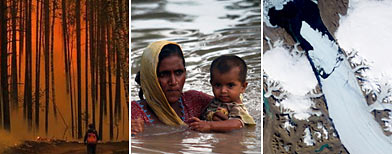
(L-R) Forest fires in Russia (AFP), Pakistani mother carries her children through floodwaters (AP), Petermann glacier (AP/NASA)

NEW YORK – Floods, fires, melting ice and feverish heat: From smoke-choked Moscow to water-soaked Pakistan and the High Arctic, the planet seems to be having a midsummer breakdown. It's not just a portent of things to come, scientists say, but a sign of troubling climate change already under way.

The weather-related cataclysms of July and August fit patterns predicted by climate scientists, the Geneva-based World Meteorological Organization says — although those scientists always shy from tying individual disasters directly to global warming.

The experts now see an urgent need for better ways to forecast extreme events like Russia's heat wave and wildfires and the record deluge devastating Pakistan. They'll discuss such tools in meetings this month and next in Europe and America, under United Nations, U.S. and British government sponsorship.

"There is no time to waste," because societies must be equipped to deal with global warming, says British government climatologist Peter Stott.

He said modelers of climate systems are "very keen" to develop supercomputer modeling that would enable more detailed linking of cause and effect as a warming world shifts jet streams and other atmospheric currents. Those changes can wreak weather havoc.

The U.N.'s network of climate scientists — the Intergovernmental Panel on Climate Change (IPCC) — has long predicted that rising global temperatures would produce more frequent and intense heat waves, and more intense rainfalls. In its latest assessment, in 2007, the Nobel Prize-winning panel went beyond that. It said these trends "have already been observed," in an increase in heat waves since 1950, for example.

Still, climatologists generally refrain from blaming warming for this drought or that flood, since so many other factors also affect the day's weather.

Stott and NASA's Gavin Schmidt at the Goddard Institute of Space Studies in New York, said it's better to think in terms of odds: Warming might double the chances for a heat wave, for example. "That is exactly what's happening," Schmidt said, "a lot more warm extremes and less cold extremes."

The WMO did point out, however, that this summer's events fit the international scientists' projections of "more frequent and more intense extreme weather events due to global warming."

In fact, in key cases they're a perfect fit:

RUSSIA

It's been the hottest summer ever recorded in Russia with Moscow temperatures topping 100 degrees Fahrenheit (37.8 degrees C) for the first time. The drought there has sparked hundreds of wildfires in forests and dried peat bogs, blanketing western Russia with a toxic smog. Moscow's death rate has doubled to 700 people a day. The drought reduced the wheat harvest by more than one-third.

The 2007 IPCC report predicted a doubling of disastrous droughts in Russia this century and cited studies foreseeing catastrophic fires during dry years. It also said Russia would suffer large crop losses.

PAKISTAN

The heaviest monsoon rains on record — 12 inches (300 millimeters) in one 36-hour period — have sent rivers rampaging over huge swaths of countryside. It's left 14 million Pakistanis homeless or otherwise affected, and killed 1,500. The government calls it the worst natural disaster in the nation's history.

A warmer atmosphere can hold — and discharge — more water. The 2007 IPCC report said rains have grown heavier for 40 years over north Pakistan and predicted greater flooding this century in south Asia's monsoon region.

CHINA

China is witnessing its worst floods in decades, the WMO says, particularly in the northwest province of Gansu. There, floods and landslides last weekend killed at least 1,117 people and left more than 600 missing, feared swept away or buried beneath mud and debris.

The IPCC reported in 2007 that rains had increased in northwest China by up to 33 percent since 1961, and floods nationwide had increased sevenfold since the 1950s. It predicted still more frequent flooding this century.

ARCTIC

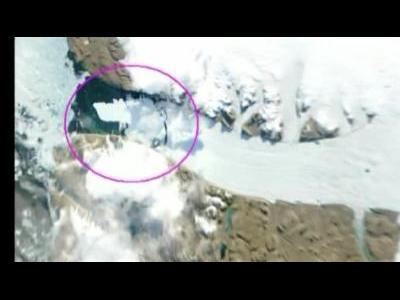
Researchers last week spotted a 100-square-mile (260-square-kilometer) chunk of ice calved off from the great Petermann Glacier in Greenland's far northwest. It was the most massive ice island to break away in the Arctic in a half-century of observation.

The huge iceberg appeared just five months after an international scientific team published a report saying ice loss from the Greenland ice sheet is expanding up its northwest coast from the south.

Changes in the ice sheet "are happening fast, and we are definitely losing more ice mass than we had anticipated," said one of the scientists, NASA's Isabella Velicogna.

In the Arctic Ocean itself, the summer melt of the vast ice cap has reached unprecedented proportions.Satellite data show the ocean area covered by ice last month was the second-lowest ever recorded for July.

The melting of land ice into the oceans is causing about 60 percent of the accelerating rise in sea levels worldwide, with thermal expansion from warming waters causing the rest. The WMO'S World Climate Research Program says seas are rising by 1.34 inches (3.4 millimeters) per decade, about twice the 20th century's average.

Worldwide temperature readings, meanwhile, show that this January-June was the hottest first half of a year in 150 years of global climate record keeping. Meteorologists say 17 nations have recorded all-time-high temperatures in 2010, more than in any other year.

Scientists blame the warming on carbon dioxide and other heat-trapping gases pouring into the atmosphere from power plants, cars and trucks, furnaces and other fossil fuel-burning industrial and residential sources.

Experts are growing ever more vocal in urging sharp cutbacks in emissions, to protect the climate that has nurtured modern civilization.

"Reducing emissions is something everyone is capable of," Nanjing-based climatologist Tao Li told an academic journal in China, now the world's No. 1 emitter, ahead of the U.S.

But not everyone is willing to act.

The U.S. remains the only major industrialized nation not to have legislated caps on carbon emissions, after Senate Majority Leader Harry Reid last week withdrew climate legislation in the face of resistance from Republicans and some Democrats.

The U.S. inaction, dating back to the 1990s, is a key reason global talks have bogged down for a pact to succeed the expiring Kyoto Protocol. That is the relatively weak accord on emissions cuts adhered to by all other industrialized states.

Governments around the world, especially in poorer nations that will be hard-hit, are scrambling to find ways and money to adapt to shifts in climate and rising seas.

The meetings of climatologists in the coming weeks in Paris, Britain and Colorado will be one step toward adaptation, seeking ways to identify trends in extreme events and better means of forecasting them.

A U.N. specialist in natural disasters says much more needs to be done.

Salvano Briceno of the U.N.'s International Strategy for Disaster Reduction pointed to aggravating factors in the latest climate catastrophes: China's failure to stem deforestation, contributing to its deadly mudslides; Russia's poor forest management, feeding fires; and the settling of poor Pakistanis on flood plains and dry riverbeds in the densely populated country, squatters' turf that suddenly turned into torrents.

"The IPCC has already identified the influence of climate change in these disasters. That's clear," Briceno said. "But the main trend we need to look at is increasing vulnerability, the fact we have more people living in the wrong places, doing the wrong things."

___

AP Correspondent Christopher Bodeen in Beijing contributed to this report.

http://news.yahoo.com/s/ap/20100812/ap_on_sc/us_sci_climate_breakdown