Tampilkan postingan dengan label storm. Tampilkan semua postingan

Rabu, 02 Februari 2011

Midwest buckles under storm, calls it a snow day

Midwest buckles under storm, calls it a snow day


A vehicle is stranded on Interstate 43 Wednesday, Feb. 2, 2011, in Grafton, Wi. The area is under a blizzard warning and some freeways were shut down.AP – A vehicle is stranded on Interstate 43 Wednesday, Feb. 2, 2011, in Grafton, Wi. The area is under a blizzard …
    By MICHAEL TARM, Associated Press 21 mins ago

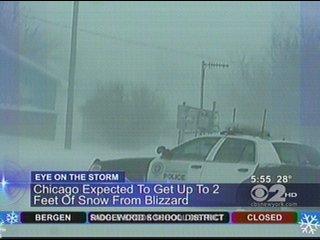
CHICAGO – A massive storm billed as the worst in decades barreled toward the northeast Wednesday, leaving vast swaths from Chicago to New York paralyzed by snow and ice, leaving hundreds of motorists stranded all night and shuttering airports and schools.

Chicago received up to 19.5 inches of snow with more still possible, and Missouri as much as 1 1/2 feet. More than a foot dropped on northern Indiana and southeast Kansas, while Oklahoma saw as much as a foot.

Spots in northern New York already had gotten more than a foot of snow by Wednesday morning. New York City was expected to get up to three-quarters of an inch of ice by midday before the mix of sleet and freezing rain warms up to rain.

Forecasters warned ice accumulations could knock down some tree limbs and power lines across the storm's more than 2,000-mile path. Ice also could affect transit service, even as plow drivers struggled to keep up with the snow on many roads.

In New York, Mike Schumaker already was into his fourth hour of what he predicted would be a 24-hour plowing marathon as he cleared snow from a suburban Albany gas station around 5 a.m. Wednesday.

"I figure I'll be going to about 1 or 2 in the morning. That's my guess," said the 42-year-old private contractor from Latham.

"It's not so much about plowing as it is about to where to put it," he said. "We still have snow from Christmas that hasn't melted."

In Chicago, the city closed public schools for the first time in 12 years and shut down Lake Shore Drive, where hundreds of motorists were stranded for 12 hours after multiple car accidents on the iconic roadway.

Bulldozers moved snow away from an estimated hundreds of cars that remained buried up to their roofs Wednesday morning after drivers had been rescued. Only then could tow trucks move in. A shuttle bus sat abandoned with its door open, letting snow blow inside and build up on the driver's seat as the radio continued to transmit.

Raymond Orozco, chief of staff to Mayor Richard Daley, said crews' efforts to rescue motorists had been "severely hampered" by snow drifts, high winds and white-out conditions.

Jenny Theroux, 23, told the Associated Press she was stranded from 4 p.m. Tuesday until about 4 a.m. Wednesday. Stranded just 800 feet from an exit, she repeatedly called the city for information.

"It was a very stressful experience toward the end, especially not knowing what's going on," Theroux said, after abandoning her car. "I'm just very confused as to why it all transpired this way."

Not only was driving dicey, but flying in and out of Chicago's O'Hare International Airport — a major U.S. hub — won't be possible until Thursday. The decision by O'Hare-based airlines to cancel all their flights for a day and a half was certain to have ripple effects at other U.S. airports, said transportation expert Joseph Schwieterman.

"Effectively shutting down America's most important aviation hub hits the system immeasurably hard," he said of O'Hare. The city's smaller airport, Midway International, had hoped to resume flights Wednesday afternoon.

By 9:30 a.m., the nation's airlines had cancelled more than 5,200 flights — or more than 16 percent of the day's scheduled traffic, according to flight-tracking service FlightAware.com. That came a day after airlines grounded 12,630 flights due to the storm.

More than 200,000 homes and businesses in Ohio began Wednesday without power, while in excess of 100,000 customers had no electricity in New Jersey and Pennsylvania, which were hit with mostly freezing rain and ice. Rolling blackouts were in Texas, including Super Bowl host city Dallas.

Outside the Philadelphia Museum of Art, a crew preparing to clear ice from the city's sidewalks sat in their van warming up before sunrise Wednesday.

One complained that getting to work — even for him — had been treacherous.

"Walking was terrible," said Rob Jones, 20, of Cenova Snow & Ice Solutions "I slid all the way down my street."

Federal Emergency Management Agency director Craig Fugate said the agency is on standby with generators, food, water and other supplies to help state and local authorities.

"The real heroes are these local responders going out in the storms and still rescuing people," he told ABC's "Good Morning America."

In Oklahoma, rescue crews and the National Guard searched overnight for any motorists who might be stranded along its major highways after whiteouts shut down Tulsa and Oklahoma City.

For those who insisted on braving the elements, the risks were many. "If you don't have enough fuel in your vehicle, you can run out, the heat goes out — and people can even freeze to death," said Greg Cohen, executive director of the Roadway Safety Foundation.

The storm's powerful punch came from cold air that swept down from Canada, clashing with warm, moist air coming up from the south, explained National Weather Service meteorologist Gino Izzo.

The most dramatic illustration could be seen earlier this week in Texas, when one part of the state reported temperatures in the single digits and another part had temperatures in the 70s with near tropical humidity, Izzo said.

"That was the breeding ground for this storm," he said.

Cities across middle America shut down hours ahead of the snow. Scores of schools, colleges and government offices canceled activities or decided not to open at all. Thousands of flights were canceled across the nation.

The NFL did manage to stick to its Super Bowl schedule, holding media activities at Cowboys Stadium in suburban Arlington as planned, though the city's ice-covered streets were deserted.

Even Chicago — with its legions of snowplows and its usual confidence in the face of winter storms that would surely crush other cities — bent under the storm's weight.

"This is nothing to play with here," said Edward Butler, a lakefront doorman peering through his building's glass doors at snow blowing horizontally and in small cyclones down the street. "This is gale force wind."

The wind gusts were strong enough to start the building's heavy revolving door spinning by itself.

Many businesses in the city planned to remain shuttered Wednesday, as did cultural attractions and universities.

Some parents were glad the city took the rare step of closing schools in a city that is normally proud of shouldering the worst Mother Nature has to offer.

"They should cancel," said Sunjay Shah, 54, a sundries shop manager stranded at a downtown hotel overnight, saying his 17-year-old son was thrilled with the snow day. "How are students going to walk or take trains (to class)?"

Providing a ray of hope to those battered by the storm, the world's most famous weather forecaster — with four legs — predicted an early spring.

Punxsutawney Phil's handlers told Groundhog Day revelers at Gobbler's Knob, a tiny hill in Punxsutawney, Pa., that the groundhog had not seen his shadow, meaning winter will end within six weeks, according to tradition.

___

Associated Press writers Karen Hawkins, Don Babwin, Sophia Tareen, Tammy Webber and Barbara Rodriguez and photographer Kii Sato in Chicago; Tom Coyne in South Bend, Ind.; Dinesh Ramde in Milwaukee; Ken Miller in Oklahoma City; Patrick Walters in Philadelphia; Chris Carola in Albany, N.Y.; Jim Salter in St. Louis; and Justin Juozapavicius in Tulsa, Okla., contributed to this report.

http://news.yahoo.com/s/ap/us_winter_weather

Sabtu, 25 Desember 2010

South getting wintry mix, storm heading northeast

South getting wintry mix, storm heading northeast


Holiday Weather DisastersPlay VideoFOX News – Holiday Weather Disasters
RELATED QUOTES
^DJI11,573.49+14.00
^GSPC1,256.77-2.07
^IXIC2,665.60-5.88
A traveler waits before going through security at O'Hare Airport in Chicago, Friday, Dec. 24, 2010. A Christmas Eve snow storm that blanketed parts ofAP – A traveler waits before going through security at O'Hare Airport in Chicago, Friday, Dec. 24, 2010. A …

NASHVILLE, Tenn. – With a rare Christmas snowfall descending on the Southeast and likely headed for the Mid-Atlantic, airlines canceled hundreds of flights and urged travelers to rethink their plans, while travel authorities warned of potentially dangerous roads.

After blanketing parts of the Midwest and hampering motorists there on Christmas Eve, the storm dipped south late Friday. Winter weatheradvisories were in effect Friday night from Missouri to West Virginia and from Iowa and Illinois down to Georgia and the Carolinas.

The wintry weather is the result of a low pressure system moving along the Gulf coast. It is expected to intensify and move northeast on Sunday to the mid-Atlantic states and New England. Just how far off the coast the low pressure system stays will determine whether areas such as Washington, D.C. get hit with snow on Sunday, said NationalWeather Service forecaster Jared Klein in northern Virginia

The weather service was forecasting possible snow for the New York and Boston areas, starting Sunday and continuing into Sunday night, with overnight temperatures in the 20s and wind gusts up to 30 mph.

The weather did not cause big problems for the airlines Friday, but Delta Air Lines spokesman Morgan Durrant said 500 weather-related flight cancellations were planned for Saturday nationwide. That included 300 of the 800 scheduled departures from the Atlanta hub. Durrant said those affected had been notified.

He recommended that passengers not travel by air in the Southeast on Christmas if they can help it.

"Atlanta will see more cancellations (Saturday) than on Sunday," he said. The Mid-Atlantic region could see cancellations Sunday.

Air Tran spokeswoman Judy Graham-Weaver said Friday evening that the carrier had only canceled two Saturday flights and was taking a wait-and-see approach to the storm.

Both airlines encouraged passengers to monitor their websites, and both offered to waive ticket-change fees for some flights scheduled for this weekend in the South and Mid-Atlantic.

In southern states, many were waiting to see whether they would enjoy a rare white Christmas.

By late Friday night, 2 to 3 inches of snow had fallen over several hours in Paducah, Ky. in the southwest part of the state, according to National Weather Service forecaster Jayson Wilson. "It's well above normal," he said.

Kentucky road crews were to load up with salt after 6 p.m. Friday for the anticipated snow in and around Louisville. Interstates and some roadways were pretreated with brine on Thursday.

Louisville last had snowfall on Christmas in 2002, when a half-inch fell.

The Weather Service said that for the first Christmas in 17 years, Nashville and Atlanta could get more than just a dusting of snow. The last time there was measurable snowfall on Christmas Day in Atlanta was in 1881, when 1.6 inches of snow fell on the city.

In the Atlanta suburb of Decatur, Vincenzo Tortorici said the prospect of snow evoked the memory of childhood Christmas visits to his relatives in Ohio.

"Snow was like frozen white icing on the cake of a magical time of my childhood," he said Friday. "I'm glad the weather might cooperate to give my own son a white Christmas this year."

In parts of Tennessee, Georgia and the Carolinas, the overnight snow was likely to be mixed with sleet and rain before turning entirely to snow. Temperatures in Georgia are expected to dip into the 20s on Christmas night, possibly leading to slick road conditions.

"If roads aren't able to dry up during the day, that's what will freeze up Saturday night into Sunday morning," said the weather service's Vaughn Smith in Atlanta.

Lon Anderson, a spokesman for AAA Mid-Atlantic, said people traveling by car on the East Coast over the holidays should check the weather forecasts.

"The fact is Mother Nature is going to be a big factor" in holiday travel, he said. "She's calling the shots this holiday season and in many places it will be very tough going." He said motorists should make sure their car is ready, especially their tires, and that they have enough windshield wiper fluid.

"It doesn't take much in the Mid-Atlantic area to cause mayhem," Anderson said.

In Minnesota, the storm brought 6 inches of snow Friday to Minneapolis and St. Paul. It pushed the monthly total there to 33.4 inches, topping the previous December record set in 1969.

The snow made traveling tough Friday in northeastern Iowa, where the bulk of the storm hovered. Cedar Rapids received more than 7 inches of snow.

Scott and Lori Whiting left Chicago for Colorado Springs, Colo., with their nine children Thursday evening. By morning, they had only reached Des Moines, a trip that normally takes about four hours, Lori Whiting said.

"The cars are really sliding around up there," Lori Whiting said. "It's kind of slushy. Some parts it's packed, and you don't think it's going to be slick and all of a sudden your car is fishtailing."

Scott Whiting got into a fender bender at a Des Moines truck stop. Still, the family was in good spirits and the children were singing carols.

Lori Whiting said they were hoping to make it to Colorado Springs for Christmas Eve.

"Depending on the number of potty breaks, you understand," she said.

Travelers could see airport screeners taking a closer look at empty insulated beverage containers like thermoses because air carriers were alerted about a potential terror tactic involving them, an administration official said.

The official, who spoke Thursday on condition of anonymity to discuss sensitive security matters, stressed that there is no intelligence about an active terror plot. The Homeland Security Department regularly alerts law enforcement about evolving terror tactics.

The Air Transport Association was expecting 44.3 million people on U.S. flights between Dec. 16 and Jan. 5 — up 3 percent over the same period a year ago but still below pre-recession travel volume. The average ticket price was $421, up by 5 percent.

The AAA predicted overall holiday travel to rise about 3 percent this year, with more than 92 million people planning to go more than 50 miles by Jan. 2. More than 90 percent said they would be driving.

Said Anderson of the storm: "The timing is really bad."

___

Contributing to this report were Associated Press writers Karen Hawkins in Chicago; Warren Levinson and Verena Dobnik in New York City; David Goodman in Detroit; Eileen Sullivan and Samantha Bomkamp in Washington; Michelle Price in Phoenix; Dylan Lovan in Louisville, Leonard Pallats and Greg Bluestein in Atlanta and Mark Pratt in Boston.

http://news.yahoo.com/s/ap/us_holiday_travel

Rabu, 03 November 2010

Haiti wants major camp evacuated ahead of storm

Haiti wants major camp evacuated ahead of storm


A child reaches out for a stuffed animal hanging to dry at the Caradeux Camp for people displaced by the Jan. earthquake in Port-au-Prince, Haiti, TueAP – A child reaches out for a stuffed animal hanging to dry at the Caradeux Camp for people displaced by …

PORT-AU-PRINCE, Haiti – It was the jewel of Haiti's post-earthquake recovery: an organized relocation camp with thousands of tents billed as hurricane-resistant, lined up in neat rows on graded mountain soil.

Now, staring down an expected hit later this week from a hurricane, officials say Corail-Cesselesse is not safe. On Tuesday, the government advised the estimated 7,850 residents of its primary relocation camp to ride out the storm somewhere else.

"We're asking people in Corail to voluntarily move from where they are and go to the houses of family or friends. The places the government has identified are churches and schools that are available for shelter from the storm," Haiti civil protection official Abel Nazaire told The Associated Press.

Camp managers held a "loudspeaker meeting" with megaphones to tell residents about the evacuation order, said Bryant Castro, the American Refugee Committee staffer managing the camp. Residents were told to seek any home they could find and are expected to start leaving as soon as Wednesday.

A hurricane over the weekend, Tropical Storm Tomas was in the central Caribbean late Tuesday with maximum sustained winds of 40 mph (65 kph), according to the U.S. National Hurricane Center in Miami. Its center was about 385 miles (620 kilometers) south-southwest of Port-au-Prince and moving west near 8 mph (13 kph).

Forecasters predicted it will veer north toward Haiti and slow in its forward movement. The forecast said Tomas was likely to strengthen over the next 48 hours, and could regain hurricane strength by Friday. A hurricane watch was issued for Jamaica, and the center said the storm could dump up to 8 inches (20 centimeters) of rain on Aruba, Bonaire and Curacao.

Tomas has already killed at least 14 people and left seven missing in the eastern Caribbean nation of St. Lucia, where it caused more than $37 million in damage. In nearby St. Vincent, the storm wrecked more than 1,200 homes and caused nearly $24 million in damages to crops, especially bananas — one of St. Vincent's top commodities.

It would be the first big storm to strike Haiti since the Jan. 12 earthquake killed as many as 300,000 people and forced millions from their homes. It would also be the first tropical storm or hurricane to hit since 2008, when Fay, Gustav, Hanna and Ike battered Haiti in the space of a month, killing nearly 800 people and wiping out 15 percent of the economy.

If it follows its predicted track it could hit every major Haitian city including Port-au-Prince, Les Cayes,Gonaives and Cap-Haitien. The U.N. Office for the Coordination of Humanitarian Affairs said rainfall of up to 5 inches (13 centimeters) could cause catastrophic floods in the severely deforested country.

Aid workers are scrambling to prepare but are badly short of supplies including shelter material because of the responses already under way to deal with the aftermath of the earthquake and an unprecedented cholera outbreak that has killed more than 330 people and hospitalized more than 4,700.

A U.S. Navy vessel, the amphibious warship Iwo Jima, was steaming toward Haiti on Tuesday to provide disaster relief.

Some of the biggest concern is for 1.3 million earthquake survivors still living under tarps and tents nearly 10 months after the disaster. The government said there are some shelters in the capital — a handful have been built in nearby Leogane and several hours north in Gonaives — but basically people will be on their own if Tomas hits.

"The government doesn't have shelters for 1,300,000 people," Nazaire said.

An enormous international aid effort flowed into Haiti in the immediate wake of the quake, but reconstruction has barely begun, in part because donors have not come through with promised funds. The United States has not provided any of the $1.15 billion in reconstruction aid it pledged last March.

When Corail opened in April, it was portrayed as a model for how camps could be built and run. A joint effort by the Haitian government and international aid groups, including U.N. peacekeepers and U.S. military engineers, it was billed as a refuge from dangerous hillside camps that Haitians had set up on their own in the days after the quake.

Corail's residents were selected from the spontaneous camp taken over by actor Sean Penn's relief organization, sprawled over a country club golf course in the capital. Residents were told they would be better off on a distant desert plain 9 miles (15 kilometers) north of the city, far from their former homes and jobs.

"I signed up. I didn't know where I was going. My home was destroyed. I had nowhere else to go," Jonel Romelus, a 36-year-old mason who moved to Corail, said Tuesday.

But an AP investigation in July revealed the site's selection was tainted by conflict of interest: The land under it belonged to the company led by the government's chief relocation adviser, Gerard-Emile "Aby" Brun. The choice put his company in position to receive government compensation for the land.

It also promised to create a community home for thousands of people who would need jobs, a boost for the Brun company's negotiations with a South Korean garment firm, Sae-A Trading Co. Ltd., to build factories next door. In September, the company signed a memorandum of understanding with Haiti's prime minister and U.S. Secretary of State Hillary Rodham Clinton to build the factories.

The day after AP's investigation was published, torrents of water and high winds from a storm collapsed 344 tents in Corail and sent 1,700 people — a quarter of the camp — fleeing for new shelters.

The dangers have only become clearer since.

"I would say ... that insufficient analysis was done on exploring all the options before selecting the Corail site," said Castro, the camp's manager. "The Corail site is located on a flood plain, and hydrologically it's not a sound location."

Oxfam spokeswoman Julie Schindall said aid workers are concerned about delivering services to the camp if roads from Port-au-Prince flood.

"This goes back to the original thing: No, (Corail is) not a safe place to live," she said. "We knew a hurricane was going to come — this is Haiti, this always happens — and we have not had a level of reconstruction that gets people under tents into houses."

At this point there is little to be done before the storm. Romelus said his family — his wife, two daughters ages 2 and 5, a sister and nephews — will stay in the camp unless the government can provide shelter. They have nowhere else to go.

"God will protect me. I'm not going to be the only one (staying Corail). If something happens, we'll deal with it," he said. "If they could have moved more quickly and built more houses, it would have been safer."

___

Associated Press reporter Evens Sanon in Port-au-Prince contributed to this article.

http://news.yahoo.com/s/ap/20101103/ap_on_bi_ge/tropical_weather