Kamis, 21 Januari 2010

New quake triggers panic in Haiti

New quake triggers panic in Haiti


New quake triggers panic in HaitiAFP iactiv – Interactive graphic on Haiti, showing the extent of the effects of last week's devastating earthquake …

PORT-AU-PRINCE (AFP) – A powerful new earthquake rumbled across the ruins of Haiti Wednesday, sending thousands of already traumatized survivors running through the streets, screaming in terror.

The 6.1-magnitude earthquake struck as dawn broke eight days after the Haitian capital was leveled by a massive temblor, measuring 7.0, that killed at least 75,000 people and left a million homeless.

"God wants to destroy all Haitians because they are bad, because they are cursed," Eleude Joseph, a shellshocked mother of two, told AFP at a squalid camp of 6,000 survivors in the Place Saint-Pierre.

'Why again?' panicked Haitians cry

There were no reports of anyone being killed or wounded by the strong aftershock, but some severely damaged buildings did come tumbling down, including the last surviving wall of the main cathedral.

Rescuers kept up their grim search through the rubble, elated by finding survivors who had defied the odds, including a five-year-old boy brought into hospital by his uncle on Wednesday.

Other survivors dug out on Tuesday included a woman, 25, found in the ruins of a supermarket, a 70-year-old woman who sang as she left behind the wreckage of the Port-au-Prince cathedral, and a 23-day-old baby girl.

Lack of water, hygiene compounds Haiti misery

But rescue efforts are likely to start being pulled back as a massive aid operation swung into gear to help hundreds of thousands trying to survive with little water in putrid makeshift camps where diarrhea was already rife.

The United States said it was pouring in 4,000 more troops, who had been due to deploy to the Middle East and Europe, while a US general said the capital's main port -- vital to moving in tonnes of aid -- should be up and running again on Friday.

Backed by three amphibious ships and a squadron of helicopters, the new troops should be in place by the weekend as the total US force helping out in Haiti swells above 15,000 in coming days.

Brazil was also looking to add 800 troops to its peacekeeping contingent in Haiti boosting its force to at least 2,000, while France and Canada both said they would send more police.

"We will be here as long as it takes, because now we have even more reason to stay," said Colonel Joao Batista Bernardes, the officer in charge of Brazil's battalion leading the UN stabilization force.

International efforts are also focusing on rebuilding the country, with a major donor conference set for Monday in Montreal.

IMF chief Dominique Strauss-Kahn called for a multilateral aid plan for Haiti on the scale of the US "Marshall Plan" that rebuilt Europe after World War II.

Strauss-Kahn said he believed Haiti "needs something that is big" as the Caribbean nation -- already one of the poorest and insecure countries in the world before the quake -- looks to the future.

Haiti's ambassador to Spain, Yolette Azor-Charles, said reconstruction could take 25 years and warned the death toll could top 200,000 as help has yet to reach many villages.

'I call, but nobody answers:' US Haitians wait for news

A 1,000-bed capacity US naval hospital ship meanwhile arrived off Haiti Wednesday with about 600 medical personnel, and was ready to start taking on board the worst of the injured.

The 70,000-tonne USNS Comfort will treat 30 to 50 patients at a time, chosen by Haitian officials from the thousands thronging hospitals and makeshift clinics.

After marines dramatically dropped in from helicopters above the presidential palace on Tuesday, troops were out in force early Wednesday patrolling streets in the business district of Haiti's quake-ravaged capital.

They ignored the looters picking through the debris -- for many scavenging from the collapsed buildings was the logical way to survive -- but ensured the security situation did not degenerate into riots.

"Look, when you are hungry and poor, nobody helps, you have to steal," one defiant young man named Vincent said, as looters plunged into the ruins of a flattened supermarket.

Haiti's City of God slum wonders about its hellish fate

Aid was still in short supply for tens of thousands of survivors, haunted by despair and the fear of more aftershocks as they inhabited the squalor of the rubble where countless bodies still lie buried.

"We were already poor before the earthquake. So now what are we?" asked Frantz Saint Hilaire, a student living in Port-au-Prince's City of God slum where desperate residents were still to see an international aid truck.

In Leogane, chaotic crowd prevents Haiti aid delivery

US Secretary of State Hillary Clinton meanwhile said Washington was working to slash through the red-tape needed to adopt children from Haiti, amid fears that thousands may have been orphaned by the tragedy.

The US government will "do all we can to expedite the travel of children who were in the line for adoption who have a legal permanent home, guardianship, waiting for them," Clinton told reporters.


http://news.yahoo.com/s/afp/20100121/ts_afp/haitiquake_12;_ylt=ArV611loUeGNKmOXJIuSRoa9IxIF;_ylu=X3oDMTE2bHFuYjJpBHBvcwMyBHNlYwN5bi1yLWItbGVmdARzbGsDZXYtbmV3cXVha2V0

By the thousands, Haiti returns dead to the earth

By the thousands, Haiti returns dead to the earth


The arm of one of a person that was killed in Haiti's earthquake sits partiallyAP – The arm of one of a person that was killed in Haiti's earthquake sits partially covered at a mass grave …

TITANYEN, Haiti – They stick out at all angles from the tall mounds of chalky dirt, the limbs of men, women and children frozen together in poses of death.

Tens of thousands more killed in Haiti's catastrophic quake lie beneath the earth in mass graves cut into this wide green hillside north of Port-au-Prince, buried anonymously and without ceremony above the turquoise waters of the Caribbean Sea.

And each day, the dead keep coming.

"I received 10,000 bodies yesterday alone," said Foultone Fequiert, 38, who was operating an earth-moving machine at one of the graves, his face covered with a T-shirt that seemed little defense against the overwhelming stench.

"I have seen so many children, so many children. I cannot sleep at night, and, if I do, it is a constant nightmare."

Despite pleas from the world that every effort be made to identify Haiti's dead, and that they be buried inshallow graves from which loved ones might eventually retrieve them, workers say there is simply no time for that — and little point.

"We just dump them in, and fill it up," said Luckner Clerzier, 39, who was helping guide trucks to another grave site farther up the road.

"If we took pictures of them you wouldn't be able to recognize them anyway," he said, gesturing toward a pile of bloated bodies baking under the hot midday sun, many tangled together in a terrible contorted embrace. The hands and feet of other victims stuck out of the ground around them.

Clerzier said workers had made every effort to cover the bodies fully, but that it had proved impossible.

"There are just too many," he said, his shadow falling on the remains of a naked infant lying on the ground a few yards from the larger mounds.

An Associated Press reporter counted 15 burial mounds at Clerzier's site, each rising 15 feet into the air and covering a wide trench cut into the ground some 25 feet deep. At the larger mass grave, where Fequiert was working, three earth-moving machines worked to cut long trenches into the earth, readying them for more cadavers.

Asked how the site could hold so many dead, Fequiert gestured toward the ground.

"They are everywhere under our feet," he said.

Titanyen, a sparsely populated wasteland, in the past has been used to dump unclaimed bodies.

It was impossible to say how many earthquake victims lay buried in the mass graves, but the Haitian government says it has already disposed of some 80,000 killed in the Jan. 12 quake, which is estimated to have killed 200,000 people. Both men said there were other sites dotted around the green rolling hills.

The mass graves are causing considerable controversy.

Two experts from the International Committee of the Red Cross have encouraged Haitian authorities to fill out a standard form on bodies so that families may later identify them and know where they are buried. The procedure includes photographing clothing, jewelry and special marks on the body, and noting where the body was found and where it was buried, said ICRC spokesman Marcal Izard.

Religious leaders — including both Roman Catholic and Voodoo priests — have also been highly critical, saying the concept of mass graves was anathema to Haitian beliefs. In Voodoo, considerable importance is placed on the regular maintenance of the tomb so that the living might honor and commune with ancestors.

"I think it is degrading. It is indecent, and it is inhuman," Max Beauvoir, the head of Haiti's main Voodoo priests' organization, told the AP. He said he had appealed to President Rene Preval to stop the mass burials, but had so far not had a response.

Precious few of the quake victims are receiving proper burials. Other uncollected bodies have been burned in the streets. Officials say they are sensitive to both religious concerns and the desire of relatives to recover the bodies of loved ones, but they argue they have had no choice but to move quickly to dispose of the tens of thousands of others.

"Of course, tradition is very important," Port-au-Prince Mayor Jean-Yves Jason Muscavin told the AP on Wednesday. "But it's a choice that had to be made. By the time we'd organized to deal with the problem, the smell had already started."

As if to underscore his point, a banner draped over the capital's main cemetery since shortly after the quake warned: "We are full. We are not taking any more bodies."

The mayor claimed the mass graves were provisional and that the government would consider using DNA later to identify victims. But such a process seemed impossible given the size of the trenches at Titanyen, where workers said large white dump trucks swiftly unloaded the dead, before earth-moving machines covered them up. They were aware of no effort to keep track of who was buried where.

Clerzier, a fisherman from the nearby village who lost a brother, a cousin and two young children in the quake, said he had become numb to his grim work. But he choked up describing what the earth had taken from him personally.

"My boy was 9, and he looked just like me," Clerzier said, gazing back toward the village where his house once stood. "I would pick him up from school and take him to swim in the sea right over there. I never would have imagined that these fields would be filled with bodies today."

Clerzier said no priest had yet been out to bless the unnamed thousands at Titanyen, an oversight he described as an outrage against their souls. But he said he expected God would overlook the slight.

"They are in heaven now, anyway," he said, walking amid the dirt-covered piles. "God is the one who made this happen, and so God will take them in."

http://news.yahoo.com/s/ap/20100121/ap_on_re_la_am_ca/cb_haiti_mass_graves

Aftershock drives more from Haitian capital

Aftershock drives more from Haitian capital


Sonsonne Semtembre, 9, center, hangs on to a tree branch as he tries to stay inAP – Sonsonne Semtembre, 9, center, hangs on to a tree branch as he tries to stay in line with others to receive …

PORT-AU-PRINCE, Haiti – A frightening new aftershock Wednesday forced more earthquake survivors onto the capital's streets to live and sent others fleeing to the countryside, where aid was only beginning to reach wrecked towns.

A flotilla of rescue vessels, meanwhile, led by the U.S. hospital ship Comfort, converged on Port-au-Prince harbor to help fill gaps in still-lagging global efforts to deliver water, food and medical help. Hundreds of thousands of survivors of Haiti's cataclysmic earthquake were living in makeshift tents or on blankets and plastic sheets under the tropical sun.

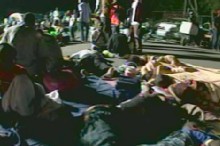
The strongest tremor since the Jan. 12 quake struck at 6:03 a.m., just before sunrise while many still slept. From the teeming plaza near the collapsed presidential palace to a hillside tent city, the 5.9-magnitude aftershock lasted only seconds but panicked thousands of Haitians.

"Jesus!" they cried as rubble tumbled and dust rose anew from government buildings around the plaza. Parents gathered up children and ran.

Up in the hills, where U.S. troops were helping thousands of homeless, people bolted screaming from their tents. Jajoute Ricardo, 24, came running from his house, fearing its collapse.

"Nobody will go to their house now," he said, as he sought a tent of his own. "It is chaos, for real."

A slow vibration intensified into side-to-side shaking that lasted about eight seconds — compared to last week's far stronger initial quake that seemed to go on for 30 seconds and registered 7.0 magnitude.

Throngs again sought out small, ramshackle "tap-tap" buses to take them away from the city. On Port-au-Prince's beaches, more than 20,000 people looked for boats to carry them down the coast, the local Signal FM radio reported.

But the desperation may be deeper outside the capital, closer to last week's quake epicenter.

"We're waiting for food, for water, for anything," Emmanuel Doris-Cherie, 32, said in Leogane, 25 miles (40 kilometers) southwest of Port-au-Prince. Homeless in Leogane lived under sheets draped across tree branches, and the damaged hospital "lacks everything," Red Cross surgeon Hassan Nasreddine said.

Hundreds of Canadian soldiers and sailors were deploying to that town and to Jacmel on the south coast to support relief efforts, and the Haitian government sent a plane and an overland team to assess needs in Petit-Goave, a seaside town 10 miles (15 kilometers) farther west from Leogane that was the epicenter of Wednesday's aftershock.

The death toll was estimated at 200,000, according to Haitian government figures relayed by the European Commission, with 80,000 buried in mass graves. The commission raised its estimate of homeless to 2 million, from 1.5 million, and said 250,000 people needed urgent aid.

Many badly injured Haitians still awaited lifesaving surgery.

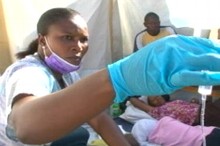
"It is like working in a war situation," said Rosa Crestani of Doctors Without Borders at the Choscal Hospital. "We don't have any morphine to manage pain for our patients."

The damaged hospitals and emergency medical centers set up in Port-au-Prince needed surgeons, fuel for generators, oxygen and countless other kinds of medical supplies, aid groups said.

Dr. Evan Lyon, of the U.S.-based Partners in Health, messaged from the central University Hospital that the facility was within 24 hours of running out of key operating room supplies. Wednesday's aftershock was yet another blow: Surgical teams and patients were forced to evacuate temporarily.

Troops of the 82nd Airborne Division were providing security at the hospital. A helicopter landing pad was designated nearby for airlifting the most critical patients to the U.S. Navy hospital ship Comfort.

The great white ship, 894 feet (272 meters) long, with a medical staff of 550, was anchored in Port-au-Prince harbor and had taken aboard its first two surgical patients by helicopter late Tuesday even as it was steaming in.

It joined the aircraft carrier Carl Vinson and other U.S. warships offshore, along with the French landing craftFrancis Garnier, which carried a medical team, hundreds of tents and other aid.

The Garnier offloaded pallets of bottled water and prepared meals at the city's quake-damaged port, while U.S. Army divers surveyed the soundness of the main pier, where trucks drove only on the edges because of damage down its center.

The seaborne rescue fleet will soon be reinforced by the Spanish ship Castilla, with 50 doctors and 450 troops, and by three other U.S.-based Navy vessels diverted from a scheduled Middle East mission. Canadian warships were already in Haitian waters, and an Italian aircraft carrier, the Cavour, also will join the flotilla with medical teams and engineers.

U.N. humanitarian chief John Holmes said at U.N. headquarters in New York that it's believed that 3 million people are affected, with 2 million of those needing food for at least six months.

Between the U.N. World Food Program and deliveries by the Red Cross and other private aid groups, about a half-million Haitians should have been reached with "reasonable quantities of food," he said. "That's still very far short of what's needed."

At the hillside tent camp, set up on a golf course where an 82nd Airborne unit has its base, the lines of hungry and thirsty stretched downhill and out of sight as paratroopers handed out bottled water and ready-to-eat meals as fast as helicopters brought them in.

In one sign of normalcy, women carried baskets of cauliflower, sweet potatoes and sugar cane into the city from farms in the hills. Some food and water was on sale in Port-au-Prince's markets, but prices had skyrocketed.

"We need money, man. I don't have enough to buy anything," said Ricardo, the newly homeless man who was seeking work and food, as well as a tent, at the golf course encampment.

Looking over the food lines there, 82nd Airborne Capt. John Hartsock said, "This is the first time I've seen it this orderly."

President Rene Preval stressed the relative quiet prevailing over much of Port-au-Prince. People understand, he told French radio, "it is through calmness (and) an even more organized solidarity that we're going to get out of this."

Concerns still persisted that looting and violence that flared up in pockets in recent days could spread. In downtown Port-au-Prince on Wednesday, dozens of men, women and children clambered over the rubble of a department store, hauling off clocks, lamps, towels, even women's hair extensions. Police stood nearby, not intervening.

The European Commission's report described the security situation as "deteriorating."

U.S. troops — some 11,500 soldiers, Marines and sailors onshore and offshore as of Wednesday and expected to total 16,000 by the weekend — were seen slowly ratcheting up control over parts of the city. Marine reinforcements were to help escort aid deliveries. One unescorted truck was seen screeching off Wednesday when a crowd grew unruly as its tents were being distributed.

The U.N. was adding 2,000 peacekeepers to the 7,000 already in Haiti, and 1,500 more police to the 2,100-member international force. That plan suffered a setback when Haiti — with historically tense relations with the neighboring Dominican Republic — rejected a Dominican offer of an 800-strong battalion, according to a Western diplomat at the U.N., speaking on condition of anonymity in the absence of a public announcement.

Other small signs of normalcy rippled over Port-au-Prince: Street vendors had found flowers to sell to those wishing to honor their dead. One or two money transfer agencies reopened to receive wired money from Haitians abroad. Officials said banks would open later this week.

But Wednesday's aftershock, the stench of the lingering dead, and the tears and upstretched hands of helpless Haitians made clear that the country's tragedy will continue for months and years as this poor land counts and remembers its losses.

After the tremor's dust settled Wednesday, street merchant Marie-Jose Decosse walked past the partly collapsed St. Francois de Salles Hospital in Carrefour Feuille, one of the worst-hit sections of town. She raised her arms to the sky, and spoke for millions.

"Lord have mercy, for we are sinners!" she shouted. "Please have mercy on Haiti."

___

Associated Press writers contributing to this report included Alfred de Montesquiou, Tamara Lush, Kevin Maurer, Michelle Faul and Bill Gorman in Haiti; Edith M. Lederer at the United Nations; Emma Vandore and Elaine Ganley in Paris, and Aoife White in Brussels.

http://news.yahoo.com/s/ap/20100121/ap_on_re_la_am_ca/cb_haiti_earthquake

Rabu, 20 Januari 2010

Haiti quake creates thousands of new orphans

Haiti quake creates thousands of new orphans


The first of 53 Haitian orphans, whose orphanage was destroyed by last week'sAP – The first of 53 Haitian orphans, whose orphanage was destroyed by last week's massive earthquake, is …

PORT-AU-PRINCE, Haiti – The 5-month-old patient at the Israeli field hospital has a number rather than a name.

No one even knows who dropped the barely conscious child at the makeshift medical center after he was pulled from the debris of a collapsed building four days after last week's catastrophic quake. Now recovering, doctors have a difficult decision ahead.

"What will we do with him when we are finished?" said Dr. Assa Amit of the hospital's pediatric emergency department.

No one knows who the boy's family is, or whether any of his relatives are alive.

Tens of thousands of children have been orphaned by the earthquake, aid groups say — so many that officials won't venture a number. With so many buildings destroyed and growing chaos in the capital, it is conceivable that many children are alone.

"As yet they are still on the streets," said Elizabeth Rodgers, of the Britain-based international orphan group SOS Children. "Without doubt, most of them are in the open."

Even before Tuesday's deadly magnitude-7.0 earthquake, Haiti, one of the world's poorest countries, was awash in orphans, with 380,000 children living in orphanages or group homes, the United Nations Children's Fund reported on its Web site.

Some of the children lost their parents in previous disasters, including four tropical storms or hurricanes that killed about 800 people in 2008, deadly storms in 2005 and 2004, and massive floods almost every other year since 2000. Others were abandoned amid the Caribbean nation's long-running political strife, which has led thousands to seek asylum in the U.S. — without their children — or by parents who were simply too poor to care for them.

International advocacy groups are trying to help, either by speeding up adoptions that were already in progress, or by sending in relief personnel to evacuate thousands of orphans to the U.S. and other countries.

On Tuesday, a flight carrying 53 Haitian children, from infants to age 10, landed in Pittsburgh, Pennsylvania, the first in a wave of orphans expected to be evacuated from the shattered Caribbean nation.

Workers disembarked the plane, some of them carrying children in their arms, and boarded waiting buses. Other children walked off the plane, waving at onlookers.

They will be taken to Children's Hospital of Pittsburgh for medical care and be placed in group homes until their adoptions are finalized.

Pennsylvania Gov. Ed Rendell and other officials escorted them from Haiti, where their orphanage was destroyed in the quake and their American caretakers spent days in dire need of food and water.

On Monday, the Dutch government sent a planeload of immigration officials to Haiti who will try to locate and evacuate 100 children who were already being adopted by Dutch parents.

Indiana-based Kids Alive International, which runs orphanages around the world, is expected to take 50 Haitian orphans to group homes in the Dominican Republic, the organization said in a news release.

U.S. Homeland Security spokesman Sean Smith said that orphans who have ties to the U.S. — such as a family member already living here — are among those who can get special permission to remain in the United States.

Notwithstanding the U.S. policy, the Catholic Church in Miami is working on a proposal that would allow thousands of orphaned children to come permanently to America. A similar effort launched in 1960, known as Operation Pedro Pan, brought about 14,000 unaccompanied children from Cuba to the U.S.

Under the new plan, dubbed "Pierre Pan," Haitian orphans would first be placed in group homes and then paired with foster parents, said Mary Ross Agosta, spokeswoman for the Archdiocese of Miami.

"We have children who are homeless and possibly without parents and it is the moral and humane thing to do," Agosta said.

Archdiocese officials said many details would have to be worked out, and President Barack Obama's administration would have to grant orphans humanitarian parole to enter the U.S.

In the meantime, U.N. humanitarian chief John Holmes said the United Nations is establishing a group whose mission on the ground in Haiti will be to protect children — orphans and non-orphans alike — against trafficking, kidnapping and sex abuse.

And orphanages that were operating in Haiti before the earthquake are scrambling to keep their kids safe, sheltered and fed. Those with damaged buildings are pledging to rebuild and take in more children, if needed.

Three of the four orphanages operated in Port-au-Prince by Planting Peace, a Melbourne, Fla., nonprofit, have been damaged, forcing staff to move everyone into one building. They are now trying to secure homes in Haitifor the kids, the group's founder, Aaron Jackson, told The Associated Press in an e-mail. Rainn Wilson, who appears in the TV show "The Office," is raising money for the group, Jackson said.

Jackson said all 37 of his orphans are physically fine and he would like to help more children.

"There needs to be some communication from the government level about what we need to do. Can we take these children?" he said. "We're ready. We've already raised a fair amount of money where we can go out and get an orphanage running soon."

Sherrie Fausey had to evacuate 30 children from her Christian Light Foundation orphanage in the capital after her facility was badly damaged in the quake.

Fausey, a former Florida elementary school teacher who came to Haiti 10 years ago, acknowledges that her job — daunting before the quake — has become even more challenging now.

"Wherever the Lord sends you, he'll make you content to be there," she said. "Times can be hard, but I'd rather be here in all this rubble. It's where my kids are."

At the Israeli field hospital, doctors are expecting to treat many more orphans in the coming days.

On one of the hospital's stretchers, Patient No. 236, a 6-month-old boy, lay on a hospital stretcher, crying in pain. Relatives brought him to the medical center shortly after the disaster, then left. They didn't tell anyone the boy's name.

Doctors suspect the infant had meningitis long before the earthquake — and they also suspect that no one is coming back for him.

"We will wait to discharge him until there is a facility that can grant continuous care," Amit said.

_________

Associated Press Writers Curt Anderson and Matt Sedensky in Miami, Dan Nephin in Coraopolis, Pennsylvania, and Edith M. Lederer at the United Nations contributed to this report.

http://news.yahoo.com/s/ap/20100119/ap_on_re_la_am_ca/cb_haiti_orphans