Tampilkan postingan dengan label hurricane season. Tampilkan semua postingan

Jumat, 28 Mei 2010

Government warns of worst hurricane season since 2005


Government warns of worst hurricane season since 2005

Hurricane Katrina. (AP Photo/NOAA)

WASHINGTON (Reuters) – The Atlantic storm season may be the most intense since 2005, when Hurricane Katrina killed over a thousand people after crashing through Gulf of Mexico energy facilities, the U.S. government's top climate agency predicted on Thursday.

In its first forecast for the storm season that begins next Tuesday, theNational Oceanic and Atmospheric Administration forecast 14 to 23 named storms, with 8 to 14 developing into hurricanes, nearly matching 2005's record of 15.

Three to seven of those could be major Category 3 or above hurricanes, with winds of more than 110 miles per hour (177 km per hour), the agency said, echoing earlier predictions from meteorologists for a particularly severe season that could disrupt U.S. oil, gas and refinery operations.

"If this outlook holds true, this season could be one of the more active on record," said Jane Lubchenco, NOAA's administrator. "The greater likelihood of storms brings an increased risk of a landfall."

In addition to the risk that major hurricanes can pose to about one-quarter of U.S. oil production and more than a 10th of natural gas output offshore in the Gulf of Mexico, this year's storms could threaten to complicate efforts to combat the environmental disaster of BP's gushing oil well.

The hurricane season officially starts on June 1 and typically peaks between late August and mid-October. An average Atlantic hurricane season brings 11 tropical storms with six hurricanes, including two major hurricanes, NOAA said.

The 2009 season, which had only three hurricanes and was the quietest year since 1997 due in part to the weather anomaly El Nino, followed several years of unusually intense activity that was particularly disruptive for U.S. energy supplies.

Other U.S. weather forecasters, including private and university researchers, also are predicting an active hurricane season.

Private forecaster WSI and Colorado State University's hurricane-forecasting team so far expect the 2010 Atlantic hurricane season to produce at least eight hurricanes, four of them major, posing a heightened threat to the U.S. coastline.

CSU forecasters are expected to ramp up their prediction for the 2010 season in a report due out on June 2.

"The numbers are going to go up quite high," William Gray, the hurricane forecast pioneer who founded CSU's storm research team, said on Wednesday. "This looks like a hell of a year."

Despite being off target in recent years, hurricane forecasts are closely watched by energy, insurance and commodities markets. Interest surged following damaging hurricane seasons in 2004 and 2005 that hammered Florida, the U.S. Gulf Coast and the Gulf of Mexico oil and gas fields.

A record four major hurricanes hit the United States in 2005, including Katrina, which killed around 1,500 people on the U.S. Gulf Coast and caused $80 billion in damage, making it the costliest natural disaster in U.S. history.

(Additional reporting by Tom Brown; Editing by Walter Bagley)

http://news.yahoo.com/s/nm/20100527/us_nm/us_hurricane_forecast

Rabu, 05 Mei 2010

Hurricane Season Could Halt Oil Spill Cleanup

Hurricane Season Could Halt Oil Spill Cleanup

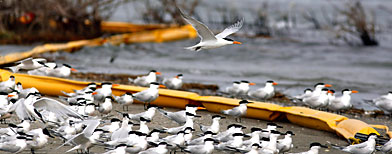
An oil boom is seen as Brown pelicans, terns and seagulls nest on Breton Island of the Gulf of Mexico.   (AP Photo/Gerald Herbert)


Obama to work 'overtime' on oil spill economic falloutAFP – Men clean a beach as US Coast Guard sailors survey a beach in Biloxi, Mississippi, as the gulf coast …

Emergency rescue crews in the Gulf of Mexico are in a race against nature to complete oil spill cleanup operations before the start ofhurricane season, which begins June 1.

"This [oil leak] could go on for 60 to 90 days or more," said Doug Helton, coordinator of incident operations for the National Oceanic and Atmospheric Administration (NOAA). "There's a lot of things that could go on in that time period that would greatly impact our model, like the fact that hurricane season is starting in a month."

The effects a hurricane could have on the spreading oil spill are impossible to predict, but one thing is certain: Cleanup efforts would have to halt completely in the face of a big storm, said Dennis Feltgen, a spokesperson for the National Hurricane Center.

"You can't have a cleanup in a hurricane. That's kind of a no brainer," Feltgen said. "You can only try to get this cleaned up with all possible speed" before hurricane season starts.

How a hurricane could impact the spread of the oil spill would depend on too many factors to calculate properly, Feltgen said.

"You could come up with all sorts of scary scenarios and make a movie of the week, but it would just be pure conjecture," Feltgen told LiveScience. "There's so much that comes into play ... [such as] the size of the spill, how deep it is, the size of the storm, the storm's angle of approach, and its forward motion."

Another interesting question is what effect the oil spill could have on a hurricane?

Feltgen said that if an oil slick is large enough - on the order of several square miles - it could slow or even prevent the genesis of a hurricane or tropical storm in the Gulf of Mexico because the oil layer would prevent the evaporation of seawater, which is crucial for a hurricane or storm to gather power.

However, if a fully formed hurricane were to barrel into the Gulf of Mexico, an oil slick - even a large one - would likely have no effect on the storm because its winds would churn the surface ocean, naturally breaking the slick into smaller pools of oil and allowing evaporation to occur.

U.S. Coast Guard petty officer Brandon Blackwell said the agency is very aware of the looming deadline.

"We're trying to mitigate the situation as quickly a possible," Blackwell said. "I'm not saying that it will be taken care of before [hurricane season starts], but we're trying our best."

Stephanie Pappas contributed to the reporting of this article.

LiveScience.com chronicles the daily advances and innovations made in science and technology. We take on the misconceptions that often pop up around scientific discoveries and deliver short, provocative explanations with a certain wit and style. Check out our science videos, Trivia & Quizzes and Top 10s. Join our communityto debate hot-button issues like stem cells, climate change and evolution. You can also sign up for freenewsletters, register for RSS feeds and get cool gadgets at the LiveScience Store.

http://news.yahoo.com/s/livescience/20100504/sc_livescience/hurricaneseasoncouldhaltoilspillcleanup

Rabu, 06 Januari 2010

Government Forecaster To Give Earlier Storm Alerts

Government Forecaster To Give Earlier Storm Alerts

Reuters

Date: 06-Jan-10
Country: US
Author: Tom Brown

MIAMI - The U.S. National Hurricane Center, citing increases in population and infrastructure along the U.S. coastline, said on Tuesday it would warn 12 hours earlier of approaching storms during this year's hurricane season.

The Miami-based hurricane center said the earlier watches and warnings for tropical storms and hurricanes would give the public and operators of oil rig platforms in the Gulf of Mexico more time to prepare for adverse weather conditions.

"Tropical storm watches will be issued when tropical storm conditions are possible along the coast within 48 hours. Tropical storm warnings will be issued when those conditions are expected within 36 hours," the center said in a statement posted on the web site of National Oceanic and Atmospheric Administration.

"Similar increases in lead-time will apply to hurricane watches and warnings," the statement added. It said recent advancements in forecasting the tracks of storms and hurricanes now made earlier warnings possible.

The changes will go into effect in the 2010 hurricane season, which begins on May 15 in the Eastern Pacific and on June 1 for the Atlantic Basin, the hurricane center said.

A renowned team of researchers based at Colorado State University predicted last month that the 2010 Atlantic hurricane season would be "above-average" in activity and produce 11 to 16 tropical storms.

The storms would include six to eight hurricanes, the forecasters said, adding that three to five could become "major" hurricanes of Category 3 or higher on the Saffir-Simpson intensity scale.

(Editing by Pascal Fletcher and Jackie Frank)

© Thomson Reuters 2010 All rights reserved

http://planetark.org/enviro-news/item/56217